Thomas Blake: Navigating ships for the Navy
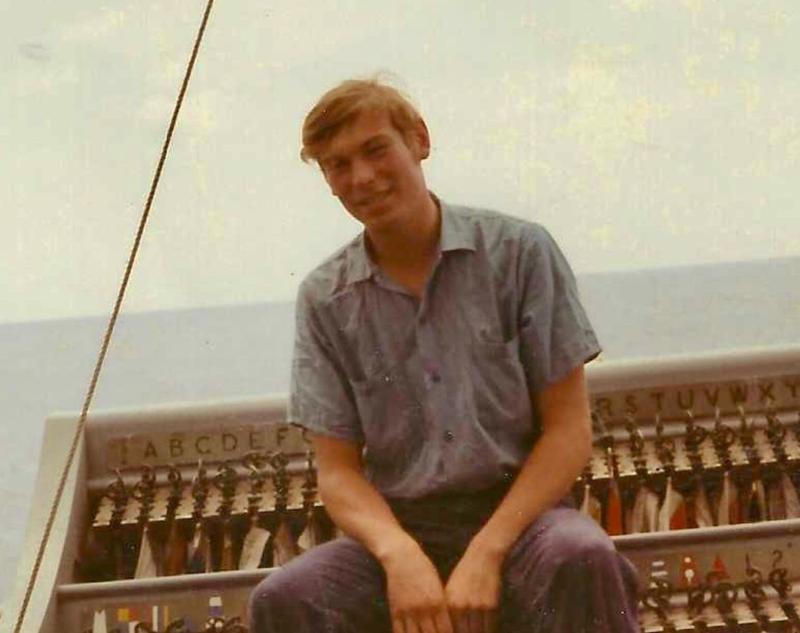 Thomas Blake
Thomas Blake
Thomas BlakeAs Boothbay Harbor prepares to celebrate the 64th annual Windjammer Days, this year’s theme proudly honors the past, present, and retired members of the United States Navy who have served our nation with dedication and distinction. Throughout the coming weeks, we will feature a series of profiles highlighting local Navy service members—sharing their stories, experiences, and the lasting impact of their service. These articles are a tribute to the men and women whose commitment to duty reflects the maritime heritage at the heart of Windjammer Days and the deep appreciation of our community. Unfortunately not all current or former Navy service members in the area can be individually featured. To have a Navy veteran or active-duty member mentioned on the Windjammer Days webpage, please email Friends of Windjammers (www.boothbayharborwindjammerdays.org). Please include name and rank.
By Thomas Blake
I was inspired to join the Navy from an early age because my uncle was a career Navy man for over 30 years, serving as Master Chief Ship's Serviceman. Throughout my childhood and early adult years, I had the privilege of hearing how honored he was to go to work each day, often starting in one place at sea or port and finishing in another area or country, doing a job he loved and working with people from all over the world.
Although I was fortunate to hear his stories, receive his letters, and feel the excitement of his Navy years and the rewards they brought him, I didn't consider joining the Navy myself until I was older. I graduated from high school (Class of 1967) and went on to attend Husson College in Bangor with my buddy, Gary Blake. We had a great time, but I don't think I took my studies as seriously as I should have. I attended college for about a year and a half before deciding it might not be for me at that time. I returned home to Southport and worked with my father for a while in the building business. The draft was beginning, and I needed to start thinking seriously about my future. We come from a small but close family. I am the only child and was fortunate to have parents, grandparents, uncles and aunts who cared about me.
My Uncle Carl, who had inspired me in the beginning, thought the Navy would be good for me. Having grown up on the coast, learning to lobster with my grandfather and later owning my own boat, I learned charts and the surrounding sea. He believed this experience would teach me discipline, training and camaraderie, as well as a darn good way to earn a living. So on Aug. 12, 1969, I drove to the Navy Recruiting Station in Augusta and with my recruiter's assistance, enlisted in the United States Navy.
It was one of the roughest and scariest days of my life but it felt good and I felt ready for what I had signed up for when enlisting in the Navy. The waiting period from enlisting to receiving my orders to report was almost the most anxious and nervous time I experienced in the Navy. During that waiting time, I received deployment requests from other military branches; however, the Navy assured me that since I enlisted with them first, my deployment would be with the Navy. I received my orders in September to report on Oct. 25 to board the bus in Portland, Maine, and embark on my pursuit for Naval Training at the Naval Training Center in Great Lakes, Illinois.
During training I spent my time in active ground training in the Great Lakes and then active training on the USS H.R. Dickerson (00708) out of Boston, Massachusetts for 14 days. Being at the Great Lakes and the Naval Training Center was a wonderful experience right from the start.
After completing my training, we received our assignments. I was assigned to report to Naval Station Newport, Rhode Island. Newport is a major training and education center, known as a “center of learning experience” and the birthplace of the Navy. 690 Peary Street, Newport, R.I., would be my address and home port. Arriving in Newport I was assigned to the USS Glover. This Garcia-class -destroyer, fitted out with advanced sonar and antisubmarine weapons, was designed to serve as an experimental research escort for developing and testing antisubmarine weapons systems. I was surprised and thrilled that she would be my home, not only for the opportunity to conduct research trials and training with my other crew members, but because the USS Glover was built and launched at Bath Iron Works. I was at the launch on that day, April 17, 1965, watching her splash down into the Kennebec River - never imagining I would be a crew mate one day. She was 414 feet long, held a crew of 239 men, and was capable of over 30 knots.
When I first started I was on deck and in charge of ensuring she was cleaned, spit-shined, and ready for inspection every day. Later in my first six months I took the Quartermaster training specializing in navigation, ensuring the ship's safe operation and assisting in various navigational tasks. After finishing my Quartermaster training, it was very rewarding. As one of the quartermasters, I was responsible for navigating the ship.
We used maps, charts and electronic navigation systems to plot the ship's course and ensure it stayed on track. We worked closely with the officers on deck and the ship's navigator. The biggest honor came in 1970, when I was on her second Atlantic Crossing and Mediterranean cruise visiting ports in Spain, France, Italy and Greece. It was an experience I will never forget; however, while there, I was fearful as well, while we were conducting tests and practicing following our own submarines in the Mediterranean we were being watched closely by Soviet Navy vessels - we had to be careful and watch our every move.
Among many memorable experiences, one of the most memorable occurred while we were underway on a particular day. As Quartermaster, you are in charge of the ship's navigation while underway, ensuring we travel in the intended direction. In this position, you work with the officers, the ship's navigator, and the helmsman. Although others help support you, you are mostly in charge of your own direction. While underway on this trip the weather conditions were not always in our favor but it always worked out. I remember it was a horrid night; the wind and sea were swaying side to side. We were headed into the Mediterranean; it was pitch black and we couldn't see anything from above. I was probably relatively young, just out of my Quartermaster training so I think my crew mates that evening were questioning our whereabouts and coordinates. One of our highest-ranking officers was called in to verify our position. He walked in (not looking happy to be awoken in the middle of the night, I'm sure), didn't say a word, walked to the navigation system and pointed to the exact coordinates on the chart—the exact spot I had us. He never said a word to the other men, but he looked at them and at me, gave a wink and said, "Don't let them make you doubt yourself, you know what you're doing,” nodded his head and left the room. I gained more confidence in that moment than is possible in a lifetime.
While aboard the USS Glover, I charted many courses, worked with great crew mates and officers, and made many friendships. When at sea we plotted courses, and while on land we were responsible for maintaining the charts and navigation. While onboard, even when the ship was in port we all still lived and stayed aboard. Because it was smaller than some of the other Navy ships, we became a close crew. We would eat together, attend church service on Sundays (which I hadn't done since I was a young boy), play cards, and go out on the town during our leave. However, you had better be back on board when you were supposed to, or you weren't going out anytime soon.
Working with the officers, I was invited to play golf. Since I had pretty much grown up on a golf course I had a pretty good handicap.
Rewarding experiences in the Navy included places we visited, such as meeting friends from home in Rome, traveling to Switzerland, and visiting Spain and Portugal again.
Around 1972, we were positioned in Boston at the Charlestown Navy Shipyard. The USS Glover was undergoing work, and we remained on watch aboard the ship. We still maintained and kept a watchful eye over her, but we had to leave more often and report back to Newport for assignments.
As my term in Boston neared its end, I began thinking more about my future and what I might like to do going forward. I concluded that I might like to return home and join my father in the building business. I met with my officers, and they agreed to my early release a few months before my enlistment term ended. I received my discharge in July 1972, leaving the USS Glover and my crew mates at 0800 and arriving in Newport, R.I. at 11:45. I received my discharge from active duty and a thank you for my three years of service; it was a great honor to be awarded the National Defense Service Medal.
As I began my journey back to Maine, I carried the honor of knowing I would still serve my country on reserve duty. As a Quartermaster I still had assignments on ships up and down the East Coast and worked with a fine group of men with whom I still share friendships today. I was honorably discharged July 28, 1975.
I greatly enjoyed my time in the Navy. I learned a lot. I got to know a great group of people, traveled to places I never would have and helped serve my country and emerged a better person than when I went in. If I could offer any advice to anyone wanting to join the Navy, do your research, talk to the recruiters. It is a commitment, but you will gain more than you ever thought. If I could do it all over again I would have stayed in the Navy longer, but I have no regrets; otherwise, I would not possibly have had the life/family I made coming back home.
As I finish this story, one last memory has always stuck with me. While finishing out my final days one of the Captains came down to say farewell. He put his hand on my shoulder and said, "Just remember, Blake, a man as a civilian can get lazy if not careful. You've done a great job here and treated us all with respect and we are sad to see you go. Please always remember you are a Navy man."
Go Navy!