Sea journeys with Don Demers
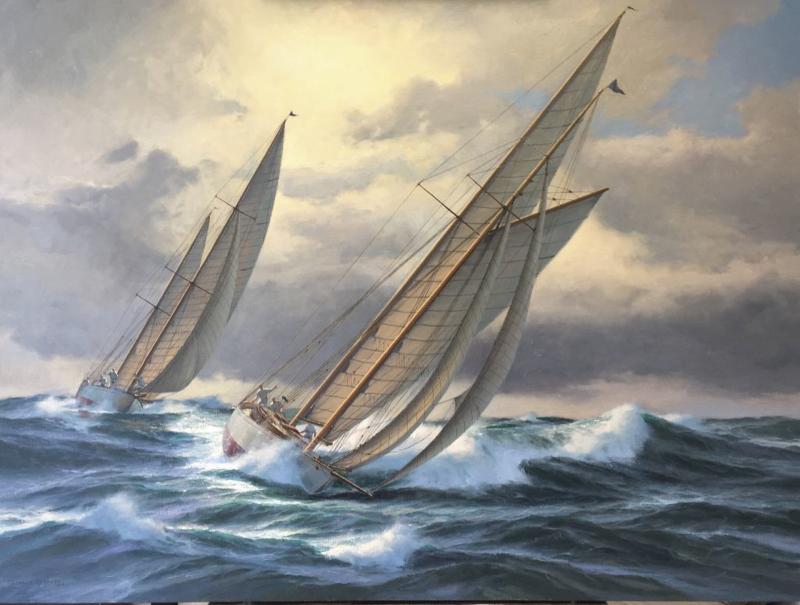 Don Demers painted "Crossing the Gulf Stream" after a trip from Newport, Rhode Island to Bermuda. Courtesy of the artist
 "Unicorn in the East River" - Don Demers
Don Demers painted "Crossing the Gulf Stream" after a trip from Newport, Rhode Island to Bermuda. Courtesy of the artist
"Unicorn in the East River" - Don Demers
"Unicorn in the East River" - Don Demers
Don Demers painted "Crossing the Gulf Stream" after a trip from Newport, Rhode Island to Bermuda. Courtesy of the artist
"Unicorn in the East River" - Don DemersOver the past 10 or so years that I’ve been writing primarily about arts, one name kept popping up: Don Demers. He was one of the artists holding painting demos at Artists Alley during Windjammer Days last year. Once, at Waterfront Park, I sought him out to catch him in action. He was painting and answering questions posed by a small, focused, group – and me.
Don has been leading workshops for decades and still enjoys it. “I like engaging with the people. I’m interested in them. I’ve met some fascinating people. It’s not only rich and rewarding to do, it’s good for me because you have to crystalize your thoughts. Over the decades, many students have become good friends.
After interviewing him at the WJD demo’s end, I told him he was on my short list of artists to write about in my Where It’s At column. That column’s time has come.
Don’s fascination with the old sailing ships began when he was just 8 years old in 1964 and saw Blue Dolphin, which he described as being of the Bermuda class vessels. Interestingly enough, when we spoke a week ago he had just bought old vintage catalogs of the James Bliss Company in Denham, Massachusetts.
“They sold ship models with all the parts and all the fittings,” Don shared. “I made that stuff like crazy as a boy just to try to figure out how these ships were made, what they were made of, and how they worked.”
The first ship Don sailed on was the Sherman Zwicker with Capt. George McEvoy on a trip to Nova Scotia. Don described it as a marginal sailing: “I remember the sea, and getting seasick. I remember the unpleasantries of the diesel smoke, and, being in the forecastle (the forward lower part of the ship), I was where the stove was. So there was a lot to get used to.”
His next adventure out to sea was aboard the Unicorn, a two-masted square rig ship. “I had a great advantage when I went aboard, because I'd studied the rigging of those ships so extensively: Their maneuvering and how they operated, so I had a theoretical understanding ... I just had to get my paws on the lines while being told what to do.”
Don described the technique used aboard Unicorn during a couple of storms, known as heaving-to in which they had to bring the forward sail back to the mast while having the rear sail filled. Back on land, Don painted Unicorn under a variety of sailing conditions in formal portraits, one of which he emailed to me for this column.
Speaking of storms, about 10 years ago, Don was aboard a ship on a delivery from Newport, Rhode Island to Bermuda. During the six or seven-day trip, they encountered a tropical depression with 45-foot seas, which he recalled as “a hell of a ride.”
In my mind’s eye, scenes from “A Perfect Storm” (insert shuddering here) came into view. Thing is, despite the threatening weather conditions, Don was noting how the ship itself was handling it all! Naturally, he did a painting of that wild ride, but chose to set the experience in the 1930s.
“I have taken those firsthand experiences and applied them many times in my career. I went to work on a schooner called Spirit of Massachusetts, and did a couple of paintings of her in different sailing positions, one down off of Antigua.”
He sailed aboard Victory Chimes as a deckhand briefly. And you can add sailing with Capt. JB Smith aboard Maine’s First Ship Virginia a few times and he will do so again for a couple of weeks this summer.
Clearly, for me anyway, those sailing experiences conveyed to canvas draw you into every painting in a palpable way to differing degrees. Don shared a fun story about his painting “Crossing the Gulf Stream,” that he and wife Jackie, also an artist, have in Rockport, Massachusetts. One day at the Demers Jones Gallery, a couple came in perusing the work and eventually ended up in front of Don’s painting of the high seas trip. “The man said he loved it, but his wife said it was because it made her sick to her stomach. Another woman said she would never hang it on one of her walls, and others have described it as frightening.”
As anyone who follows this column knows, I love nothing better than diving into paintings and I couldn’t resist a trip into “Crossing the Gulf Stream,” in which those sensory memories Don draws from find full expression. The sea was what captured my attention – initially. Not being a swimmer, I found the scene to be quite alarming. I’m thinking the crew on the ship in the foreground seem to be considering taking down a sail or two, while the captain is gripping the ship’s wheel – a real man vs nature scene. On the ship behind a couple of crew members are paying close attention to the one ahead of them, ready to do what they can if need be. This painting simultaneously filled me with trepidation and awe.
Right now, Don is at work on a large commission of six paintings of the first six U.S. Navy frigates built in 1812. He said it requires an enormous amount of work that begins with reading the history of each rig and time period. He shared an interesting fact: All six were built in rapid succession by shipwrights so skilled, they didn’t use plans or drawings! Drawings were done much later by naval architects. As he finishes reading about each ship, images begin taking shape. Of course, before taking graphite to paper, Don will begin with a technical study of each ship. After the graphite sketches, he’ll paint them in gouache or watecolor.
“It’s a complicated visualization stage,” Don said. “Historical accuracy is a must. The individual who commissioned the series is an avid and very knowledgeable collector. He is interested in evocative, historically correct paintings.”
As always, I was curious about what continues to jazz the creative I was speaking with about his work. Said Don, "You would think if you’ve done something for decades it would become routine, but I am continually fascinated by the act of painting. By the use of paint and effects that can be achieved ... And inspriring people.”
Visit Don and Jackie’s website for more information and paintings: https://www.demersjonesgallery.com/