Challenges ahead for Maine's healthcare systems
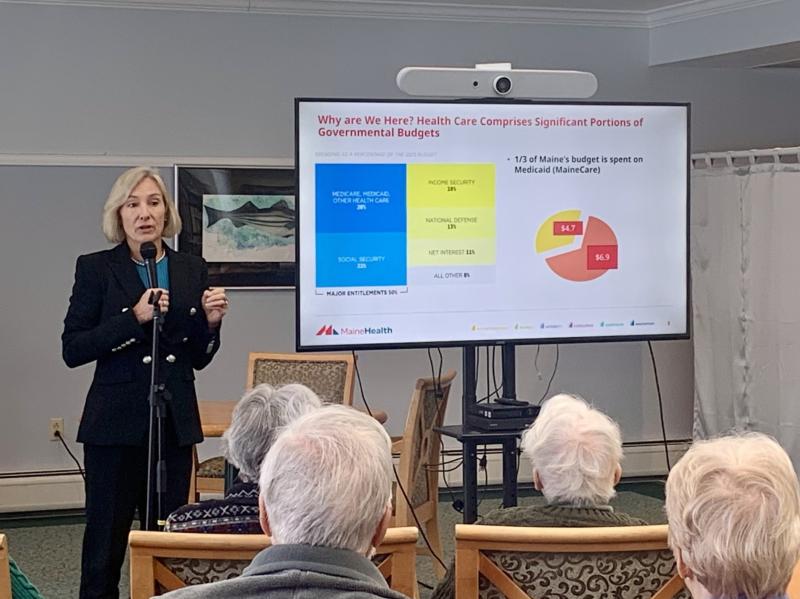 Katie Harris, MaineHealth’s vice president of government affairs, talks upcoming healthcare challenges expected to hit Mainers. ISABELLE CURTIS/Boothbay Register
Katie Harris, MaineHealth’s vice president of government affairs, talks upcoming healthcare challenges expected to hit Mainers. ISABELLE CURTIS/Boothbay Register
Katie Harris, MaineHealth’s vice president of government affairs, talks upcoming healthcare challenges expected to hit Mainers. ISABELLE CURTIS/Boothbay RegisterChallenging times are ahead for the MaineHealth hospital system, said Katie Harris, MaineHealth’s vice president of government affairs, at a Jan. 30 lecture at St. Andrews Village.
Harris explained that these upcoming difficulties are largely due to health care costs reaching a tipping point, caused by three main factors: the affordability of insurance for patients and employers, significant government spending on the growing Medicaid and Medicare programs and a shift in federal priorities. The result is unprecedented activity aimed at reducing health spending at the federal, state and local levels.
Harris said a third of Maine's budget is spent on Medicare (Mainecare). Medicaid and Medicare also make up 28% of the federal budget; in comparison, national defense is 13%.
Meanwhile, campaigns have emerged that villainize hospitals as the cause behind the high health spending. “It's really hard to understand exactly what is driving their desire to have hospitals targeted in this way, other than they believe that policy changes can impact hospitals probably more effectively than they're going to impact all the other factors that impact cost,” said Harris.
She acknowledged, hospital costs are a problem. But she believes positive change comes from looking at the broader picture of health systems, rather than focusing on one aspect.
Changing federal interests are also affecting Maine's healthcare. Some areas of impact Harris identified include the disruption to the supply chain caused by tariffs, funding from the National Institutes for Health (NIH) and other research grants, vaccine policy changes, and actions around gender affirming care and immigrant enforcement, among others.
“(It's) just creating a lot of uncertainty in our worlds.”
The passage of HR 1 (“Big Beautiful Bill”) is expected to cause about 50,000 Mainers under 65 to lose coverage. This means healthcare providers will see reduced Medicaid benefits and payments for services, as well as an increased need for charity care. MaineHealth is expected to lose more than $48 million annually.
"The federal government is really shifting the burden from (itself) to the states. So, when you look at (Maine’s) demographics and our financials, it creates a really problematic picture in terms of how we are going to fill the gaps,” said Harris. Currently, Maine is the oldest state by population age, the second most rural and ranks 35th in median income.
The statistics for the state’s hospitals are not optimistic, either. Maine ranks fifth in both poverty and facility age, and second in terms of debt. Hospitals already take on the stress from other system failures, such as boarding people for extended periods due to the lack of long-term elder care and residential places for children with behavioral health needs, and these burdens are only expected to increase, explained Harris.
“Maine hospitals are starting from a very poor starting point.”
However, there are positives. Despite its heralds, Lown Institute identified MaineHealth as the fourth best health system in the country for equity, value and outcomes.
MaineHealth is also expected to receive about $190 million this year from the Rural Health Transformation Program. While it won't completely negate the effects of the Big Beautiful Bill, the goal of the program is to create sustainable rural health ecosystems through strengthening the workforce, bridging the affordability gaps for patients and providers and encouraging technological innovation.
“There are some pretty stringent criteria, so we're hopeful that we're able to maintain that level of funding, but that is a substantial amount of money for the state of Maine to invest in transforming rural health care.”
As these new policies take effect, Harris expects a shift towards outpatient care and providers embracing technology to ease their workloads, such as using AI note-taking.
"It's going to be bumpy at times, but we're going to do our absolute best to ensure that we're meeting the mission and vision and, through our values, providing the best care that we can for you."