Planning board upholds request for stormwater management plan
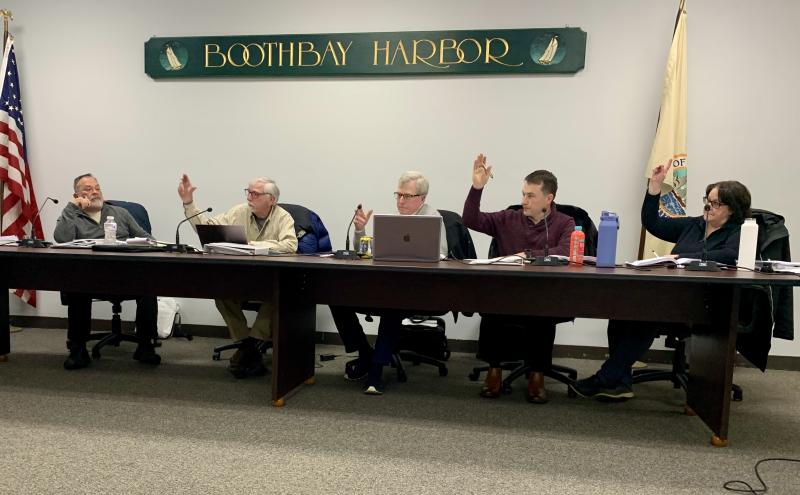 The Boothbay Harbor planning board votes 4-1 to uphold its request for a stormwater management plan. ISABELLE CURTIS/Boothbay Register
The Boothbay Harbor planning board votes 4-1 to uphold its request for a stormwater management plan. ISABELLE CURTIS/Boothbay Register
The Boothbay Harbor planning board votes 4-1 to uphold its request for a stormwater management plan. ISABELLE CURTIS/Boothbay RegisterBoothbay Harbor Waterfront Preservation (BBHWP)’s East Side Park was the main topic April 8 for Boothbay Harbor’s planning board as members reviewed a motion to reconsider its request for a stormwater management plan from BBHWP.
BBHWP’s attorney, Anthony Muri, and the board, with questioning led by member Merritt Blakeslee, addressed each of the motion’s five arguments against the request:
(1) The planning board should afford the park’s application to amend the plan approved in 2020 a lower degree of scrutiny than it would an initial site plan application; (2) the board should rely on the 2020 approval, which implicitly found the park’s stormwater runoff measurements “adequate;” (3) because the state statute (Title 38, 420-D) governing stormwater management contains an exemption for properties less than one acre, the town's ordinance must be interpreted to contain the same exemption; (4) creating a stormwater plan would be unduly burdensome on BBHWP; (5) the code enforcement officer’s “failure” to notify the park of the incompleteness of the supporting materials unfairly prejudiced the park.
Referring to the second argument, Muri explained that Title 9, Section 170-56 would have stood in the way of an approval in 2020 if there was a concern about stormwater runoff. He also said the need for a stormwater management plan is a two-part process. First, it needs to be determined whether post-development runoff is greater than pre-development. If so, that's when the need for a plan is triggered.
However, Blakeslee said the plans provided in 2020 were erroneous, including the amount of impervious surface. There was an opposing discussion between Muri and Blakeslee, with Muri arguing that whether or not there was an error, it was part of the planning board's final determination, for which no appeal was taken. Blakeslee said he was not persuaded that the matter was a done deal and couldn't be reconsidered.
Another concern Blakeslee raised was how the splash pad had enlarged from about 25 feet in diameter in the 2020 plan to 42.5 feet. Muri said that was a non-issue as the pad had a drain to funnel stormwater into the public sewer.
There was a question about whether stormwater can enter the public sewer system. Town officials were unsure and said Boothbay Harbor Sewer District would have to be consulted.
The abutter’s attorney, Kristin Collins, said she had received information from the sewer district that it would accept the park’s stormwater, only if it were the best option, and that there was a closing valve that prevented marine water, snow melt and runoff from entering the collection system.
“So, that water will not go down the drain; it will go down the site. It's a sloppy piece of land, and the harbor is right there ... It's time to be cautious about these things,” she said.
No clear conclusion was reached.
In closing remarks, Muri reiterated that a stormwater plan was not needed as the conclusion was clear; there was an about 60% reduction in impervious surface between pre-development and post-development, and a plan was only required if runoff was greater post-development. “There isn't any way in all of God's creation that you could have more runoff than you had predevelopment. It's simply not possible.”
“I take your point, but again, the ordinance is looking for that judgment to be confirmed by an engineer, and it's as simple as that,” Blakeslee returned.
Concerning the other arguments, Blakeslee said he did not see where the ordinance supported the first, or how the statute cited in the third suggested the municipal ordinance couldn’t impose more stringent stormwater requirements. “To the contrary, the statute twice expressly endorses the possibility that a municipal stormwater ordinance may exceed ... the statute,” he said.
The fifth asked the Code Enforcement Officer (CEO) to go beyond their job purview, and that the CEO does not have final judgment on completeness, the planning board does, Blakeslee said.
David Cody then proposed the board not require a stormwater management plan. The motion was not seconded. The board then voted 4-1 to uphold its original request, with Cody opposed.
There was a brief talk between the board, Muri and Collins about when certain provisions or permits will expire. Both attorneys agreed to send a written timeline to the board.
The planned completeness review for BBHWP’s site plan application was rescheduled to the board’s May 13 meeting, due to a missed deadline on BBHWP’s part. The board determined a May 1 deadline for additional information from BBHWP, and May 6 for the abutters. They also discussed setting up a site visit before the meeting.
In other business, the board conducted a completeness review for Chuck and Jeanne Fuller’s site plan application and shoreland permit to operate Fuller Marine Construction at 85 Atlantic Ave.
Chuck Fuller recently purchased the property and said at the meeting that he was going through the application and permitting process as the new owner, not because he planned to make any property change. After reviewing, the board voted to give the Fullers a compiled list of additional information they needed to bring before the board.