The Ozone Mountain mystery
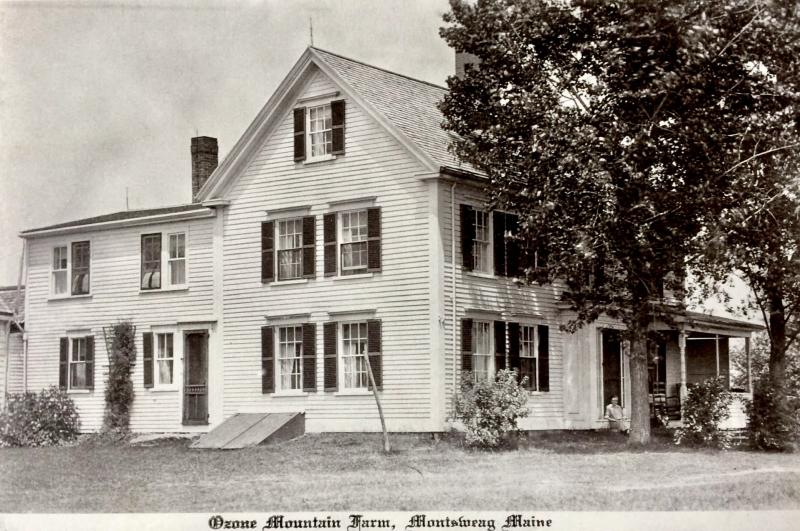 The home of Wilson Bailey and his wife Jennie is no longer standing. Courtesy of Woolwich Historical Society
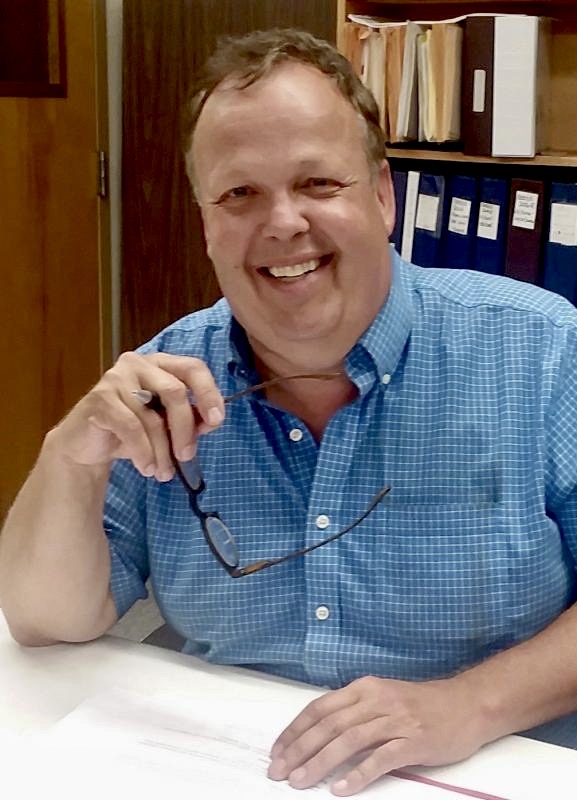 Selectman Jason Shaw remembers the Wilson Bailey farm and helped solve part of the mystery of Ozone Mountain. PHIL DI VECE photo
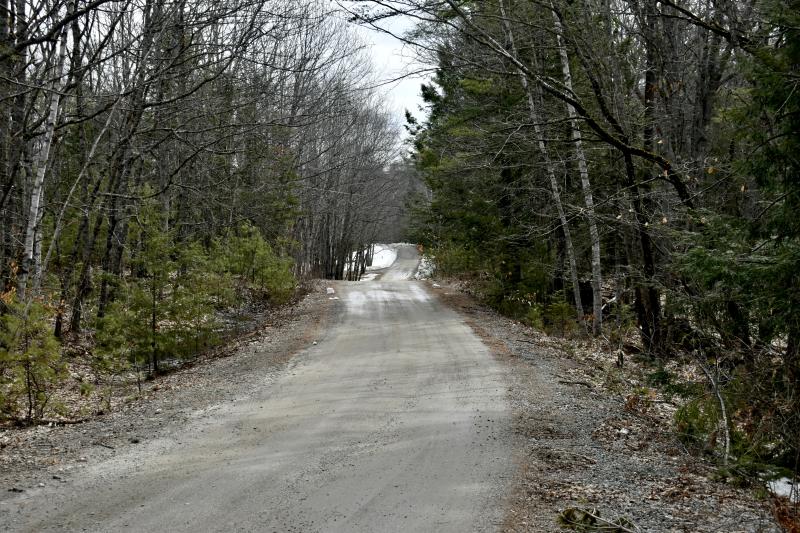 Looking downhill on the private dirt road leading to the top of Ozone Mountain. A number of homes were built on the summit of the high hill where over the years the trees have grown up, obscuring the view of the surrounding countryside. PHIL DI VECE photo
The home of Wilson Bailey and his wife Jennie is no longer standing. Courtesy of Woolwich Historical Society
Selectman Jason Shaw remembers the Wilson Bailey farm and helped solve part of the mystery of Ozone Mountain. PHIL DI VECE photo
Looking downhill on the private dirt road leading to the top of Ozone Mountain. A number of homes were built on the summit of the high hill where over the years the trees have grown up, obscuring the view of the surrounding countryside. PHIL DI VECE photo
Looking downhill on the private dirt road leading to the top of Ozone Mountain. A number of homes were built on the summit of the high hill where over the years the trees have grown up, obscuring the view of the surrounding countryside. PHIL DI VECE photo
The home of Wilson Bailey and his wife Jennie is no longer standing. Courtesy of Woolwich Historical Society
Selectman Jason Shaw remembers the Wilson Bailey farm and helped solve part of the mystery of Ozone Mountain. PHIL DI VECE photo
Looking downhill on the private dirt road leading to the top of Ozone Mountain. A number of homes were built on the summit of the high hill where over the years the trees have grown up, obscuring the view of the surrounding countryside. PHIL DI VECE photo
Ask anyone who lives in Woolwich for directions to Ozone Mountain and they’ll probably say something like, “Sorry, I’ve never heard of it, or any mountain in Woolwich.” But for years the name has persistently appeared on topographical maps showing it halfway between Hunnewell Lane and Gray Corner Road. Don’t look for it because you can’t see it from either road, or Route One, the trees having grown up all around it.
I first noticed the name when I was tracking down another geological feature called “Whaleback Ridge,” a set of rolling hills that doesn’t look anything like a whale. Both are in an area of Woolwich called “Montsweag," known for its popular summer flea market and a nearby restaurant of the same name. Long ago in the “Gay Nineties,” that is to say the 1890s, Montsweag was a more important place. It was mostly cleared pasture land then and home to farms, an apple orchard and several early industries including a brickyard, lumber mills and tannery. The mills were located along a tidal stream called Montsweag Brook that borders the town of Wiscasset. Nearby was a small railroad stop of the former Knox & Lincoln Railroad. The focal point of the Montsweag community was the Grange hall where a general store and post office were located and folks would gather on the second floor for political meetings, contra dances and religious lectures. Next door was the old Montsweag Baptist church. The grange building is still there, you’ll find it across from the flea market and now home to OceanPlanet Energy. The Baptist church is gone, only its cement front steps remain.
Ozone Mountain is a mile or so west of here where the terrain rises gradually to a height of 190 feet; 58 meters if you prefer. It doesn’t come close to qualifying as a mountain and I haven’t found anything in a historical context concerning how Ozone Mountain got its name, who named it that, or why.
Debbie Locke at the Woolwich Historical Society told me she couldn’t find any mention of Ozone Mountain within a “History of Woolwich, Maine – A Town Remembered.” The book, a must read for anyone with even a passing interest in Woolwich, was compiled by the town’s historical society and published in 1994. Debbie suggested I get in touch with Jason Shaw, a member of the Woolwich Select Board.
A few days after that I met Jason at Jack Shaw & Sons excavating & construction business where Jason works alongside his father, Jack Shaw the town’s longtime road commissioner. Jason’s sister, Tammy Given, is the company’s office manager. Both Tammy and Jason are longtime members of Woolwich’s Historical Society based in the Farmhouse Museum located next door to the town office on Nequasset Road. Tammy also posts many of the historical facts and pictures appearing on the group’s informative web page.
“I think I know the place you’re talking about, and if I’m correct we can drive right to the top of it,” Jason told me as we climbed into his red company pickup truck and started off. “I’m not positive but I think where we’re going is the highest spot in Woolwich.” In just a few minutes we were bumping along a private dirt road taking us gradually uphill. Jason explained the area was part of a fairly recent housing development called fittingly enough, “Mountain Estates.” At the top where the hill flattens off there are half dozen handsome homes nestled among towering pine and broadleaf trees. Jason has a remarkable memory and recalled how a few years back Andy Cromwell of Westport Island had been the developer here. Better still, he had Andy’s phone number and was able to get in touch with him as we sat in the truck parked near the summit of Ozone Mountain.
Andy had been a building contractor in this area before retiring. As you might expect he was kind of surprised by the phone call but more than willing to help once Jason explained what we wanted to know. He said he now lives in Yankeetown, Florida, a small community on west coast where he spends a good deal of his time recreational fishing in the gulf. The temperature down there that morning was in the low 80s. Andy told us he’d purchased 50 acres of Ozone Mountain in 1988 adding that years before his great uncle Ed Cromwell had owned the property. I remembered Ed Cromwell and knew Andy’s parents having met them when I resided on Westport. It was Andy who extended the gravel road from Hunnewell Lane and had electrical service run to the summit. He told us in 1995-96 he built a large two-story home for himself, later adding a separate building to serve as his woodworking shop. In the years since the workshop was remodeled into an attractive home. Andy recalled on a clear day the view from the second floor of his home was spectacular. He said originally the property was part of the Wilson Bailey farmstead, a place that came to be known as “Ozone Mountain Farm.” Andy couldn’t tell us how the lofty hill had gotten its name, “As far as I know it’s always been called that and I built my house at the top of it.”
Sometimes prominent hills, streams, or crossings are named after a person, like Day’s Ferry in Woolwich, named for the Day family, or Langdon Mountain in Wiscasset named for Timothy Langdon, an early settler. Langdon Mountain, too, isn’t much more than a lofty hill about 180 feet in elevation. It, too, must have looked more prominent when the countryside around it was cleared pastureland as was the case a hundred years ago with Ozone Mountain.
One theory for how Ozone Mountain got its name suggests because of its higher elevation the air here was purer and better for you. In bygone days naturally occurring ozone, i.e., the clean scent following a summer thunderstorm, was thought to be good to breath. It was fashionable in the 1890s for city folk to spend at least part of the summer vacationing in the mountains, or at the seashore where the air was fresh and healthier. Today, when we think of ozone, we associate it with smog, which is something harmful to breath when the ground levels are too high.
I found something of interest online, a black & white postcard showing a two-story clapboard farmhouse, the caption beneath it reading: “Ozone Mountain Farm, Monstweag, Maine." Tammy cleared up this mystery identifying this as the Wilson Bailey farmhouse, a home once located a short walk south from the junction of Walker and Gray Corner roads. The house fell into ruin years ago and was torn down. It stood alongside a former road that once linked Hunnewell Lane with the Walker Road. A topographical map from the 1940s shows the house on the eastern slope of Ozone Mountain. Tammy found a picture of the house in the town’s archives, taken from a different angle than the postcard. Wilson Bailey and his wife Jennie were well-known in the Woolwich community; Wilson served for many years as a schoolteacher and school superintendent. He was a 50-year member of the Grange. The selectboard dedicated the 1956 Town Report to him.
A 1943 newspaper clipping, also discovered by Tammy, tells of the Baileys hosting a gathering recognizing members of the town’s Army Air Corps. This organization was a part of the former Aircraft Warning Service (AWS) established by the American Legion during World War II. Volunteers in Woolwich, Wiscasset and Edgecomb took turns watching the skies for enemy aircraft from observation posts established in their communities. From the news clipping, we learned the Bailey farmhouse served as Woolwich’s observation post headquarters. The lookout post itself was located somewhere on the Bailey property perhaps at, or near, the top of Ozone Mountain.
In closing, please bear in mind that Ozone Mountain is all privately owned and shouldn’t be explored without permission. A number of private homes dot the hill’s southern slope and summit. Whatever scenic view there might have been from the top is now entirely obscured by trees. The opposite side of Ozone Mountain also privately owned and remains largely undeveloped being densely wooded with a few marshy areas and exposed ledge. A special thank you to Jason Shaw and Tammy Given for their help in compiling this story.
Phil Di Vece earned a B.A. in journalism studies from Colorado State University and an M.A. in journalism at the University of South Florida. He is the author of three Wiscasset books and is a frequent news contributor to the Boothbay Register/Wiscasset Newspaper. He resides in Wiscasset and be contacted at wiscassetnewspaper.com