CSD school committee sends warrant to voters
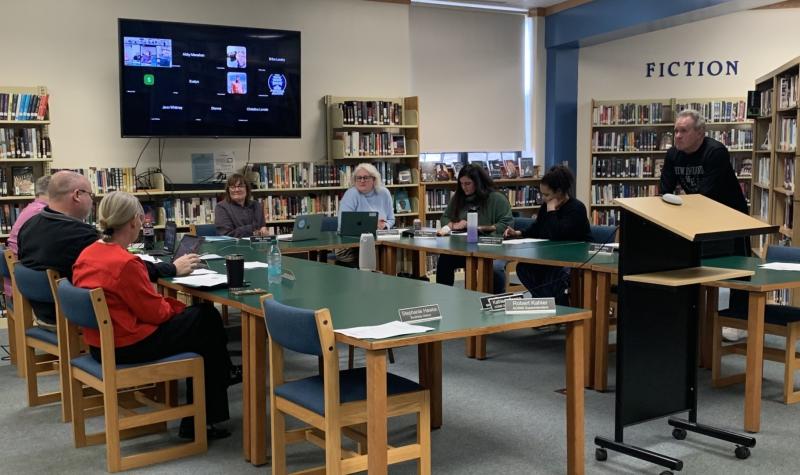 The CSD school committee approves warrant articles April 14 for public vote . ISABELLE CURTIS/Boothbay Register
The CSD school committee approves warrant articles April 14 for public vote . ISABELLE CURTIS/Boothbay Register
The CSD school committee approves warrant articles April 14 for public vote . ISABELLE CURTIS/Boothbay RegisterApril 14, the Community School District (CSD) school committee voted 4-1 to approve the fiscal year 2026-27 warrant and set a June 9 budget validation referendum. Tom Perkins was the opposing vote for both. Stephanie Hawke was not present.
The first public vote for warrant approval is on April 28 at 6 p.m. at the Boothbay Region Elementary School (BRES) gym. Boothbay and Boothbay Harbor residents will vote at their respective town offices June 9 on the validation referendum.
The proposed $12,153,371 budget is a $745,958 (6.5%) increase from FY25-26. Boothbay is responsible for $8,165,413, about 67% of the cost allocation, which is a $427,608 (5.5%) increase from last year. Boothbay Harbor is responsible for $4,043,396, a $338,640 (9.1%) increase.
During the April 14 meeting, Alternative Organizational Structure (AOS) 98 Superintendent Robert Kahler revealed that Trevett students were being miscategorized as Boothbay Harbor residents. This error has been fixed, and Boothbay Harbor’s allocation has decreased from original estimates.
Article 18 on the warrant would allow the committee to transfer amounts exceeding 5% of the total appropriation of any cost center (facilities maintenance, regular education, school administration, etc.) to another cost center, if it does not increase the authorized total school budget. The committee is already allowed to move amounts less than 5%.
Kahler explained that this provision lets excess monies be transferred to cover costs in another sector in the event of an emergency, such as the flooding at BRES in 2023. This would also avoid the costs to host special meetings to transfer money the district already has.
Perkins expressed discontent with the article, and Kahler reiterated it would be for one-off events, and if money was continually being moved from one sector to another, then that would be a budget issue to be addressed.
In other business, Kahler said the recent state changes to the Essential Programs and Services (EPS) formula are not expected to change the state subsidy for the CSD. The EPS formula determines the state and local share of funding needed for each school administrative unit (SAU) and is a standardized way to compare one school’s allotment to another.
The CSD’s school data is available through the ESSA Dashboard on Maine’s Department of Education (DOE) website. This includes figures on per pupil spending, demographics, teacher qualification, state assessments and more. The 2025-26 data will be available after the school year ends.
Tense conversation broke out between Perkins and fellow members about the EPS formula and number accuracy. The cost per pupil for the FY26-27 school year, as determined by the state, will not be available until next year. According to Maine DOE, it does not include expenditures for community services, capital outlay and debt services in its calculation.
By taking the FY26-27 budget ($12,153,371) and dividing it by the number of CSD students (370), Perkins said the CSD was spending about $33,000 per pupil.
“I know that you can come up with all sorts of state formulas, but, you know, that's what people are going to take a look at,” he said.
Tory Paxson agreed that was a fair assessment of how people would do the math. “(However), if they are comparing that number to what they can find about other schools, I hope that they realize that they're using a very different formula ... I would hope that is also part of the story that you're telling, because I think that fact does matter.”
Jennifer Whitney asked if Perkins would clarify the misconception if a constituent asked why the CSD was spending $33,000 per student. Perkins responded that he wouldn’t, because he doesn’t think it's a misconception.
“It is our job to be saying correct information, and if you're not doing that as a board member, that is concerning,” said Whitney.
In other business, the Student Transfer Agreements (Superintendent Agreements) appeal process has changed. This deals with the transfer of a student from their residential SAU to another. There are several levels of appeal if the original request is denied by the superintendents, and adjustments were made to the final level, when the issue goes before the State Board of Education. This includes no new evidence being presented at the appeal, a recommendation that the concerned parties fill out a common form to standardize the procedure, and board deliberations will now be made privately.
“I think that's going to make it easier for (the board) to make what is always a hard decision, so that was encouraging,” said Kahler. He added that the CSD is involved in at least one appeal a year.
Attendee Lori Perkins asked about superintendent agreements that involve the children of CSD employees who reside outside the region but attend CSD schools. She asked if the agreements apply to both teachers and staff, or just teachers.
Attendee BRES school counselor Lacey Phelps added, “Our ed techs are essential support employees who deserve the same equity as teachers do when bringing their families to our school. They’re who we require in order to open our doors every day and keep them open.”
Kahler clarified that the agreement applies to any staff member’s child.
Athletic Director Allan Crocker, who is on the board of directors for the Midcoast Hall of Fame, encouraged anyone who knows a former Seahawk who deserves to be honored to reach out. “I don't want to just be people that Mr. Crocker thinks deserves to be in the Hall of Fame,” he said.