Cafe Sci reveals new deep-sea organisms
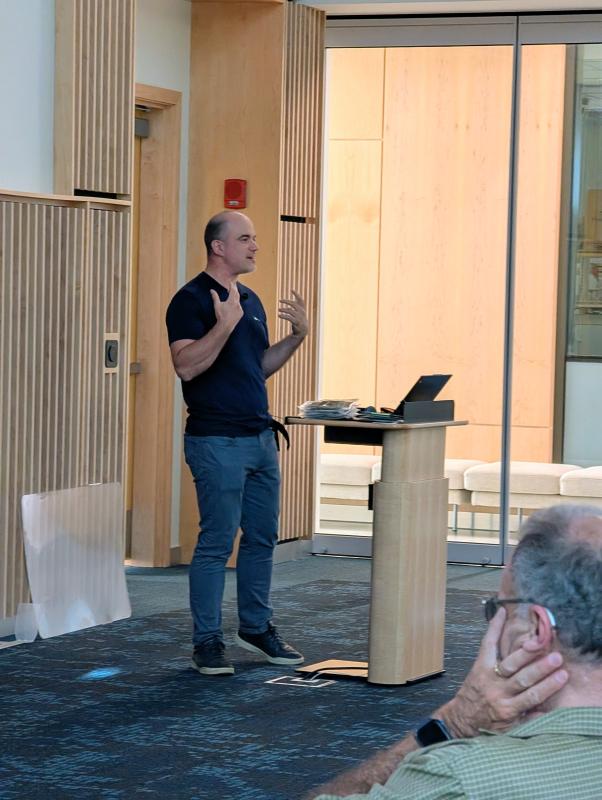
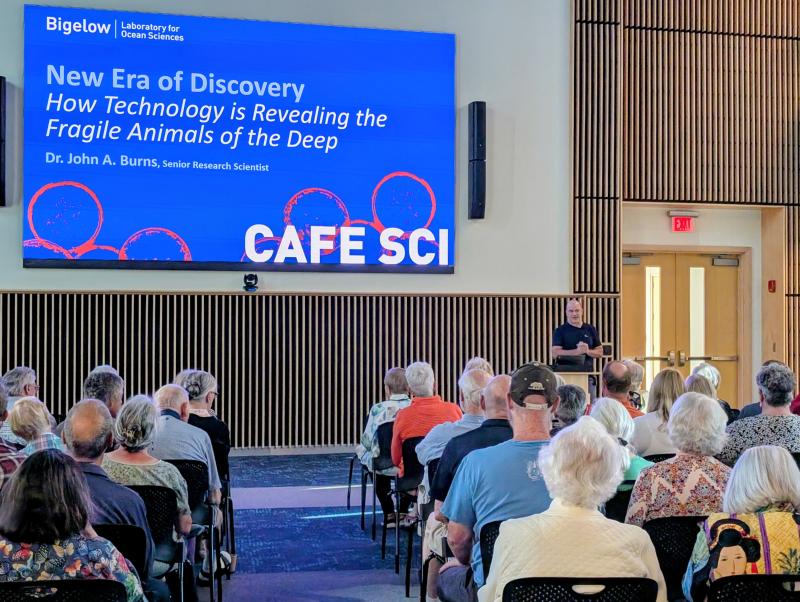 Dr. John Burns presents “New Era of Discovery: How Technology is Revealing the Fragile Animals of the Deep. “CANDI JONETH/Boothbay Register
 CANDI JONETH/Boothbay Register
 CANDI JONETH/Boothbay Register
 CANDI JONETH/Boothbay Register
 CANDI JONETH/Boothbay Register
Dr. John Burns presents “New Era of Discovery: How Technology is Revealing the Fragile Animals of the Deep. “CANDI JONETH/Boothbay Register
CANDI JONETH/Boothbay Register
CANDI JONETH/Boothbay Register
CANDI JONETH/Boothbay Register
CANDI JONETH/Boothbay Register
CANDI JONETH/Boothbay Register
Dr. John Burns presents “New Era of Discovery: How Technology is Revealing the Fragile Animals of the Deep. “CANDI JONETH/Boothbay Register
CANDI JONETH/Boothbay Register
CANDI JONETH/Boothbay Register
CANDI JONETH/Boothbay Register
CANDI JONETH/Boothbay RegisterThirty-one new species in just two weeks of exploration in the South Atlantic Ocean’s vast midwater range – that’s what researchers Dr. John Burns and Dr. David Fields of Bigelow Laboratory for Ocean Sciences (BLOS) discovered in April, off the coast of Brazil. And they’re just getting started. Some scientists estimate there may be between 50,000 and one million unknown species at these depths. Advancements in digital imaging, robotics and genomics are helping scientists move beyond the limits of human perception, into a new paradigm of science, led by non-invasive technologies that create 3D models of these fascinating new creatures and their environments.
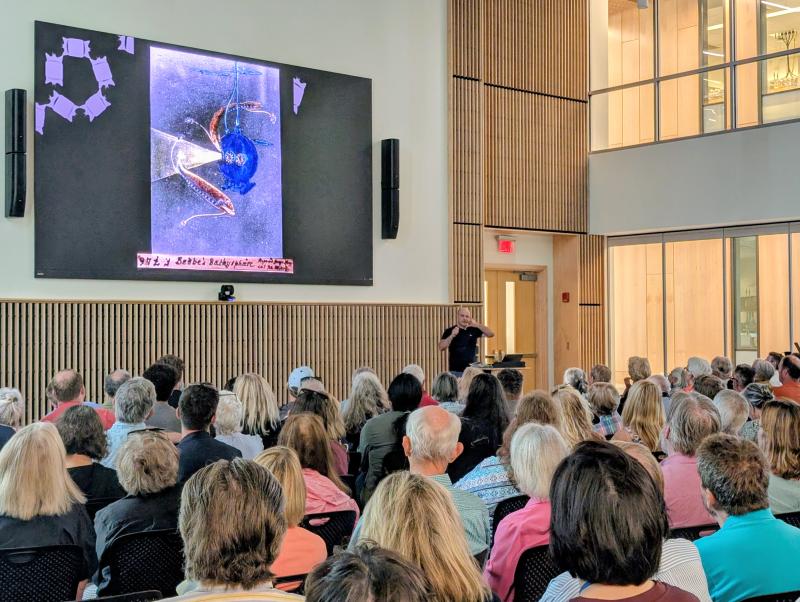
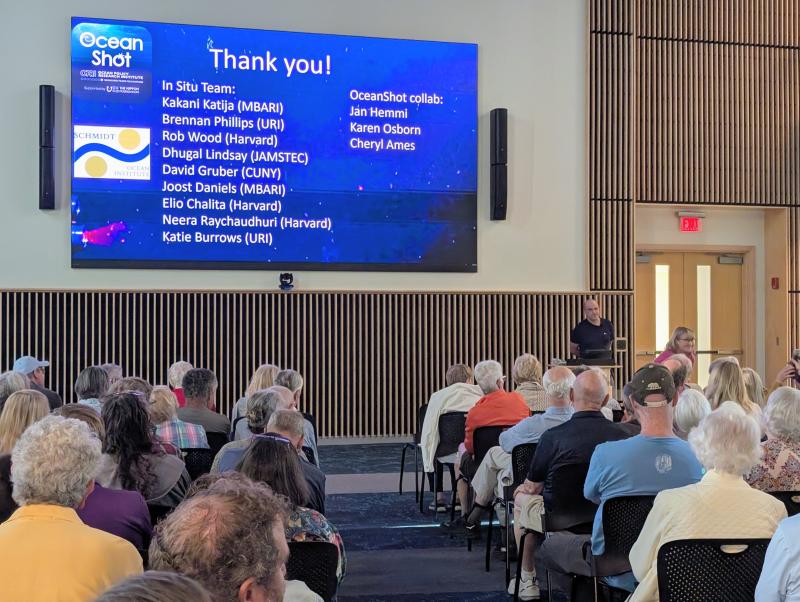
Attendees of BLOS’s third Café Sci lecture, "New Era of Discovery: How Technology is Revealing the Fragile Animals of the Deep," sponsored by Corient (formerly H.M. Payson), were in for a special treat. Burns showed video after video, image after image, of new organisms he and his team have discovered.
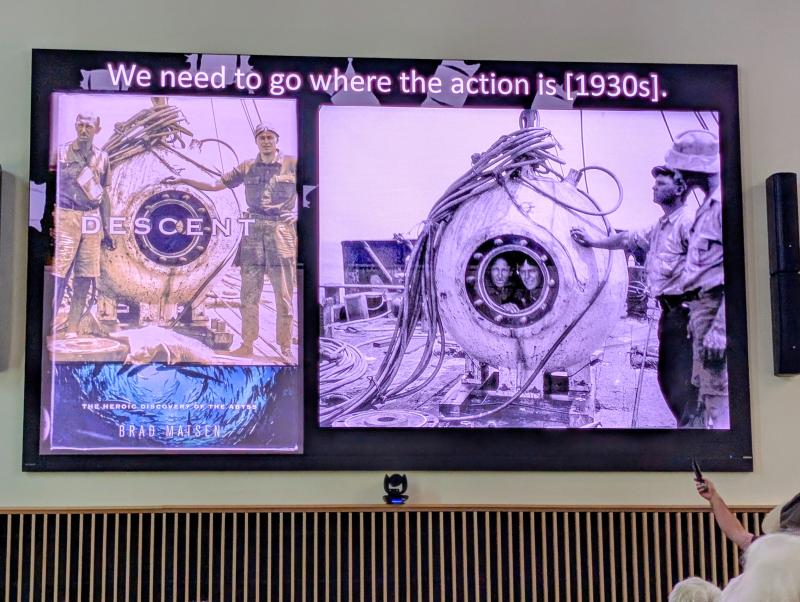
Historically, Burns said, understanding marine life has been biased toward animals with "hard parts," such as shells or bones because soft-bodied organisms like jellyfish and siphonophores do not preserve well. When these "fragile" creatures are brought to the surface, they often lose their structural integrity. Early explorers had to rely on descriptions and artistic reconstructions, which were sometimes dismissed by the scientific community as impossible. But innovation continues to offset the challenges of studying deep-sea marine life. Remotely operated vehicles (ROVs) take us to new depths, and new tools, like his underwater laser, now identify new species without the need for collection. Collecting, researching and disseminating information, a process that might have taken 21 years in the past, can now be done in hours.
To study these animals in their natural environment without destroying them, Burns and his international cohort of researchers use imaging systems, including an underwater laser that creates MRI-like scans and creates 3D models in real time. Other technologies such as soft robotics use flexible materials like silicone, rubber and fabrics to create bendable robots that encase species and take scans of their interior structures. Sometimes tissue samples are taken which can then go through genome sequencing, and larger samples are used to provide eDNA data, clueing scientists into population numbers of the species. The entire process is catch-and-release, if catch is needed at all.
The images Burns shared with the audience best captured the excitement of seeing new animals for the first time: Periphylla, a large jellyfish that releases a cloud of bioluminescent cells when disturbed, deep-sea worms which use modified tentacles as antennae to sense sugars and ammonia in the water to find prey or mates, an ultra-black anglerfish whose specialized skin absorbs 99.5% of light to remain invisible, Ctenophores of several varieties, including one species about the size of a basketball, Salpa that produce cellulose and hyaluronic acid, and Siphonophorae, a relative of the Portuguese man-o'-war that reached lengths of 30 feet.
The lecture will be viewable on BLOS’s YouTube channel in the coming weeks.
The final Café Sci lecture of 2026, "Resilient Reefs: How Algae-Grazing Fish Maintain Balance in Coral Ecosystems,". is Aug. 12 at 5 p.m. on the campus in East Boothbay. The popular talks routinely gather about 200 on-site guests and more on Zoom. Advance registration is recommended.