BHPD’s new software protects family, property
 Boothbay Harbor Police Department makes protecting loved ones and vacant properties easier with new online databases. ISABELLE CURTIS/Boothbay Register
Boothbay Harbor Police Department makes protecting loved ones and vacant properties easier with new online databases. ISABELLE CURTIS/Boothbay Register
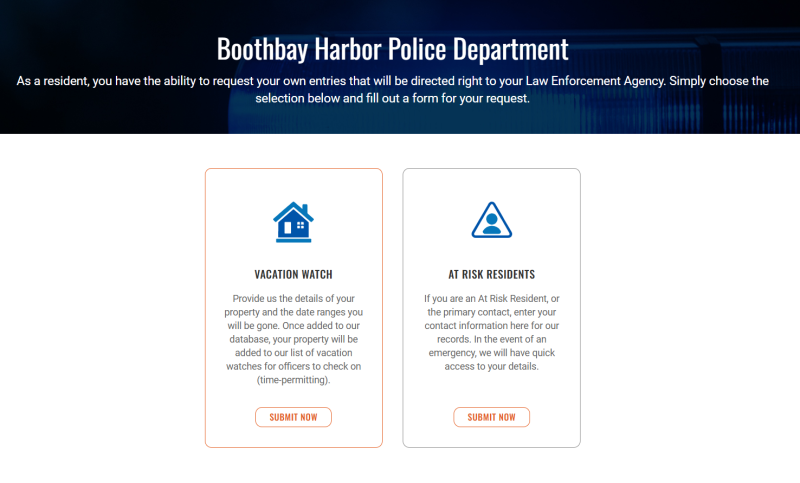
Boothbay Harbor Police Department makes protecting loved ones and vacant properties easier with new online databases. ISABELLE CURTIS/Boothbay RegisterBoothbay Harbor Police Department (BHPD) just got an upgrade with new online databases streamlining two community programs: “At-Risk Residents” and “Vacation Watch.” People can sign up under the BHPD section on the town website or in person.
“These systems aren't new. It's just a more efficient way of doing it,” explained Police Chief Doug Snyder.
At-Risk Residents provides officers with identifying physical and behavioral details on people who may be at an increased risk due to age or cognitive impairment, such as dementia or Alzheimer’s. Having this information readily available allows for a smoother process and less time spent gathering insight from family members, said Snyder. For instance, people can input their relative's habits, such as frequent dining spots, so an investigating officer knows where this person might be found.
People can also list whether their relative is part of Lincoln County Emergency Management Agency’s (EMA) Project Lifesaver program, which equips county residents with a wrist or ankle band that emits a silent radio frequency to track them in case of emergency. This way, BHPD can immediately call in EMA personnel when a loved one is reported missing.
“We've used it a couple of times, and it's worked great."
While At-Risk Residents is often used for older family members, Snyder encourages people to add their children to the database, especially as people regularly forget simple information when they’re panicking.
“If we have that information here, we don't have to worry about asking so many questions."
Vacation Watch is another upgrade from BHPD’s previous paper system. In this database, residents provide property details and dates of vacancy, and officers check the property (when time permits) for any visible signs of a break-in, burst pipes or sounding alarms. The time of each check-in is recorded, so officers can vary visit times to avoid pattern detection if there is suspicious activity, according to Snyder. There is no minimum number of days a resident must be gone to qualify.
“I don't see an issue with it if (a homeowner is gone for) two days, 60 days or 90 days. The only caveat to it is that we're not guaranteeing that we're going to get to your house every day.”
An email will be sent to the homeowners each time their property is reviewed. Personal information will not be shared with the public and will be automatically deleted from the database when the vacancy period ends.