Waterfront Preservation requests planning board chair’s recusal
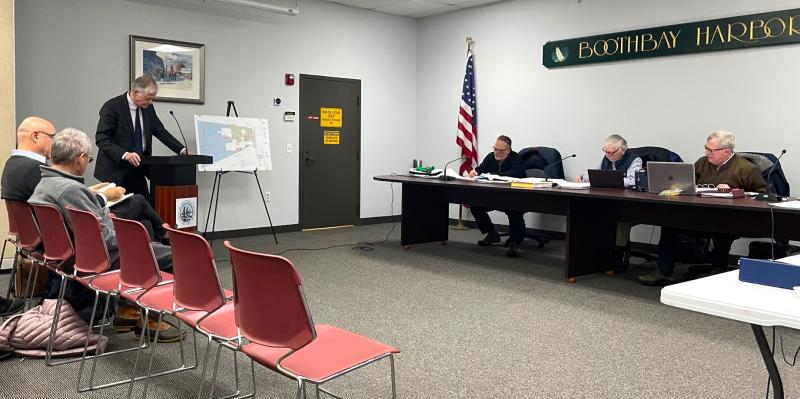 Boothbay Harbor Waterfront Preservation attorney Anthony Muri, left, presents a pre-application amended site plan to the planning board Dec. 10. Pictured board members, from left, are David Cody, Merritt Blakeslee and Chair Thomas Minerich. FRITZ FREUDENBERGER/Boothbay Register
Boothbay Harbor Waterfront Preservation attorney Anthony Muri, left, presents a pre-application amended site plan to the planning board Dec. 10. Pictured board members, from left, are David Cody, Merritt Blakeslee and Chair Thomas Minerich. FRITZ FREUDENBERGER/Boothbay Register
Boothbay Harbor Waterfront Preservation attorney Anthony Muri, left, presents a pre-application amended site plan to the planning board Dec. 10. Pictured board members, from left, are David Cody, Merritt Blakeslee and Chair Thomas Minerich. FRITZ FREUDENBERGER/Boothbay Register Boothbay Harbor Waterfront Preservation (BBHWP) requested that the planning board chair recuse himself from decisions concerning its application for Eastside Waterfront Park. In a Dec. 16 motion to the town, the organization asked that Thomas Minerich be recused.
“Minerich should recuse himself from all prospective proceedings relating in any way to Preservation's efforts to secure the approvals required by applicable law in connection with its development of the park. Should Minerich decline to do so, we respectfully request that the remaining members of the board exercise their authority to disqualify him,” the motion says.
In the document, BBHWP questioned Minerich’s impartiality on the park and scrutinized his residential project at 51 Union St. Among the organization's arguments, it claims the project disregards land use ordinance requirements, including shoreland and floodplain zoning. BBHWP also said the permitting process has been mishandled, claiming Minerich underpaid application fees and omitted information in permit applications, or deviated from them.
BBHWP said Minerich is an “unreliable municipal officer who failed to apply the provisions of the land use ordinance in an even-handed and impartial way," and BBHWP should not be required to submit its case to a planning board that includes such a member.
Minerich declined to comment but said the motion will be discussed by the planning board at its next meeting. “The only statements that I plan to make regarding the motion will be during the Jan. 14 planning board discussion,” he said.
The Register also reached out to Code Enforcement Officer Geoff Smith for comment but has not received a reply.
The motion followed a Dec. 10 planning board pre-application meeting on an amended site plan, largely regarding the park’s contentious splash pad. However, BBHWP President John O’Connell said the motion was not in direct response and had been in development for some time.
At the meeting, the planning board asked for a list of information to be provided for the application’s review. The board requested further details, including around site plan performance standards, application standards, and safety issues.
“I want to be sure that all of our legacy when we walk away from all this, that the planning board, the park, everyone is looked at as doing their homework and doing it right. And people can enjoy that place for years and years to come. So, there are things that we need to know, OK?” Minerich said, opening the floor to questions from board member Merritt Blakeslee.
Blakeslee said he personally found the plan and its notes “cryptic.” He said, “I think all of us on the planning board were surprised at how little you've given us, and then have come in for our comments on what you've given us. Because there's not a lot here.”
BBHWP representatives, likewise, seemed surprised at the response, expecting they had met requirements. Board members said the information was sufficient for a pre-application, but the board's composition has changed since the project was first presented to the town, requiring additional details.
“I think what was said originally was that most of the members here are new, and they don't have the background. So, for them to agree to this amendment without understanding what it was originally makes it almost impossible,” Minerich said.
The board also heard from the abutters’ representation. According to abutter attorney Kristin Collins, the amended plan is deficient enough to be abandoned in favor of a new one. She said there were issues, including stormwater management, wastewater treatment and shoreland zoning.
“Because this was called a park from the beginning, some sort of liberties were taken, or grace was given in the idea that it would just be this public asset,” Collins said, adding that the deed could open the doors to possible commercial development.
“There is no deed restriction on this property that says it's a park. It can be developed this way, and that pavilion could become something commercial. The whole thing could be taken advantage of and used in a different way five months after approval. And we should treat it with the same scrutiny we treat any commercial development that comes to town.”
O’Connell told the Register that, although BBHWP's intention is to stay a nonprofit, applying deed restrictions would be irresponsible because it would significantly reduce the value of the property. He said BBHWP hasn't handled it yet because the organization is focused on opening the park.
"If we can't do what we need to do, which is build a park, then we're not going to reduce the value of our investment by putting restrictions on it,” he said. “Our donors are fine with what we're doing. And, at some later point when we've got the park completed, we'll figure out what the ultimate best ownership system is. It's certainly a nonprofit."