Weaving history in ash and sweetgrass
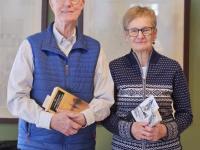
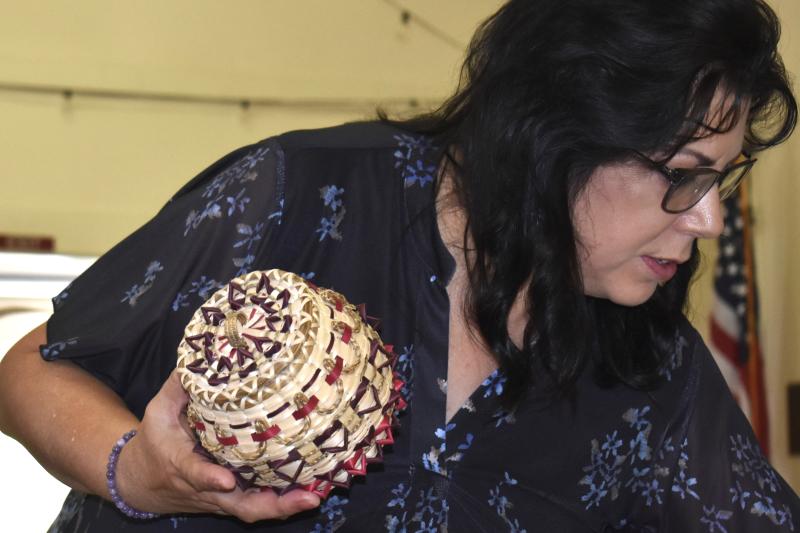 Guest speaker Passamaquoddy basket maker Debora Nicholas at Southport Town Hall July 25. LISA KRISTOFF/Boothbay Register
 Brown or black ash is the base for all Passamaquoddy baskets. LISA KRISTOFF/Boothbay Register
 LISA KRISTOFF/Boothbay Register
 An attentive audience of 25 attended the presentation by Debora Nicholas at Southport Town Hall. LISA KRISTOFF/Boothbay Register
 Sweetgrass grown by Debora Nicholas and family in Maine. LISA KRISTOFF/Boothbay Register
 Brown ash and sweetgrass vase. Debora Nicholas, 2021, exhibited at UME Hudson Museum. Courtesy photo
 A Debora Nicholas wedding cake basket, 2024. Courtesy photo
  Gnome by, and courtesy of, Debora Nicholas.
 Holiday tree by, and courtesy of, Debora Nicholas.
  Debora Nicholas with her aunt, Clara Neptune Keezer, nationally known for Passamaquoddy basketmaking and teaching. Courtesy of Debora Nicholas
Guest speaker Passamaquoddy basket maker Debora Nicholas at Southport Town Hall July 25. LISA KRISTOFF/Boothbay Register
Brown or black ash is the base for all Passamaquoddy baskets. LISA KRISTOFF/Boothbay Register
LISA KRISTOFF/Boothbay Register
An attentive audience of 25 attended the presentation by Debora Nicholas at Southport Town Hall. LISA KRISTOFF/Boothbay Register
Sweetgrass grown by Debora Nicholas and family in Maine. LISA KRISTOFF/Boothbay Register
Brown ash and sweetgrass vase. Debora Nicholas, 2021, exhibited at UME Hudson Museum. Courtesy photo
A Debora Nicholas wedding cake basket, 2024. Courtesy photo
Gnome by, and courtesy of, Debora Nicholas.
Holiday tree by, and courtesy of, Debora Nicholas.
Debora Nicholas with her aunt, Clara Neptune Keezer, nationally known for Passamaquoddy basketmaking and teaching. Courtesy of Debora Nicholas
Debora Nicholas with her aunt, Clara Neptune Keezer, nationally known for Passamaquoddy basketmaking and teaching. Courtesy of Debora Nicholas
Guest speaker Passamaquoddy basket maker Debora Nicholas at Southport Town Hall July 25. LISA KRISTOFF/Boothbay Register
Brown or black ash is the base for all Passamaquoddy baskets. LISA KRISTOFF/Boothbay Register
LISA KRISTOFF/Boothbay Register
An attentive audience of 25 attended the presentation by Debora Nicholas at Southport Town Hall. LISA KRISTOFF/Boothbay Register
Sweetgrass grown by Debora Nicholas and family in Maine. LISA KRISTOFF/Boothbay Register
Brown ash and sweetgrass vase. Debora Nicholas, 2021, exhibited at UME Hudson Museum. Courtesy photo
A Debora Nicholas wedding cake basket, 2024. Courtesy photo
Gnome by, and courtesy of, Debora Nicholas.
Holiday tree by, and courtesy of, Debora Nicholas.
Debora Nicholas with her aunt, Clara Neptune Keezer, nationally known for Passamaquoddy basketmaking and teaching. Courtesy of Debora NicholasA vivid memory of Passamaquoddy basket designer/maker Debora Nicholas’ youth was the sound of male family members pounding ash logs of 8-12 feet with a mallets or the back of an axe to split the wood and separate the growth rings that would be reborn as “splints” for basket making.
“Every morning was fresh; nice and cool. They'd be out there pounding the ash with others doing the same thing. The sound is like echoes of music, almost like drumming and kind of like a heartbeat. It sounds so cool ...," shared Nicholas prior to the start of her basket making presentation at Southport Town Hall July 25. This event was part of Hendricks Hill Museum’s Summer Lecture Series.
Nicholas grew up in Washington County on the Passamaquoddy Tribal Land of Pleasant Point (Sipayik), in Perry. She’s a member of the Neptune Family, nationally known for both traditional and innovative Passamaquoddy basket making, and sweetgrass braiding, techniques. Nicholas learned the art from the master basket makers in her family – her mother and two aunts. Her mom, Edith Neptune Pond, became renowned for her skill of simultaneously braiding six-strand braids of sweetgrass into 100 yard-long cords; Aunt Theresa Neptune Gardner is known for her intricate, multi-color basket designs of ash and sweetgrass; and Aunt Clara Neptune Keezer, who mastered the traditional basket technique, created original basket designs that brought her recognition by the National Endowment for the Arts with a National Heritage Fellowship Award in Washington, D.C. in 2002.
Uncle Peter Neptune Pond has been recognized as a traditional arts fellow preserving complex Sipayik ash containers and sweetgrass harvesting traditions. The sweetgrass he uses grows in and around the marshes of Pleasant Point. Nicholas also noted her uncle is a prominent member of the Brown Ash Task Force created to protect the trees from the emerald ash borer, which threatens the habitat of these all important links to the past, present and future.
Nicholas said her aunts nurtured her interest in learning the art of basketmaking. Nicholas made her first basket, with cover, when she was 16, and went on to apprentice under her Aunt Clara for several years.
For the presentation, Nicholas brought materials and tools used to make Passamaquoddy baskets: a block of brown ash, an axe and mallet, and strippers and splitters to prepare and transform the ash for every basket.
She explained finishing touches run the gamut for each skill level from ash ribbons, natural and dyed, to areas of woven sweetgrass. Nicholas stressed the importance of keeping the splints, weavers, uprights and stakes damp. Some people use a spray bottle; others, like Nicholas, have a cup of water next to them. Each piece must be dampened before being woven into the basket. If one breaks, it means starting over again.
After sharing this lengthy and time-consuming process, Nicholas moved on to the array of baskets made by her and other members of the family – including her eldest daughter’s bookmarks.
Nicholas’ creations included baskets with tops, adorned with ribbons and sweetgrass, Christmas trees and gnomes; and an aunt’s baskets in shapes of pumpkins, strawberries, blueberries and flowers; and vases. In photo only, she shared her three-tier wedding cake basket. Factoring working full-time, she spent three months making it, from the sweetgrass wedding bells cake topper, to the three tiers that open for small keepsakes, the decorative wooden curls (resembling a variety of natural textures), points and very complex folded weaves from paper-thin splints. The cake is on exhibit at the University of Maine Hudson Museum in Orono.
In closing, Nicholas said, “I like creating things and I see art in everything. I also like teaching because if you don’t teach these traditions, they get lost.”