News Center's Don Carrigan reports live from Southport
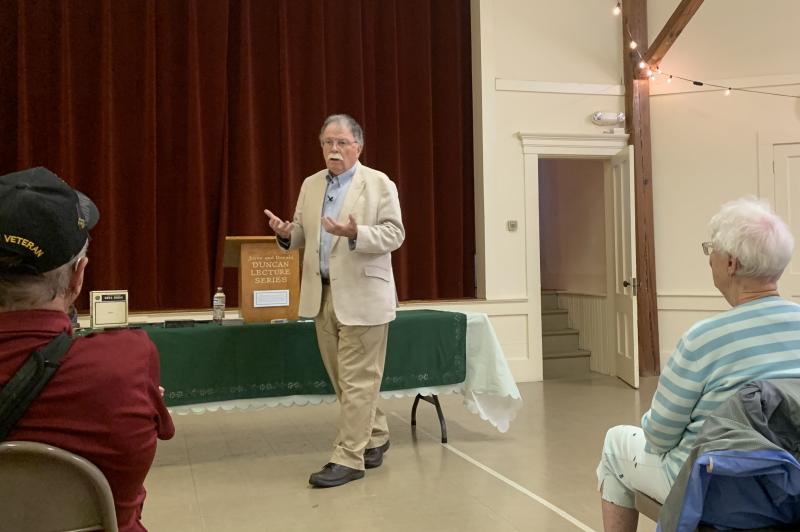 News Center Maine's Don Carrigan visits Southport Town Hall to share personal and professional insights with a packed house July 28. ISABELLE CURTIS/Boothbay Register
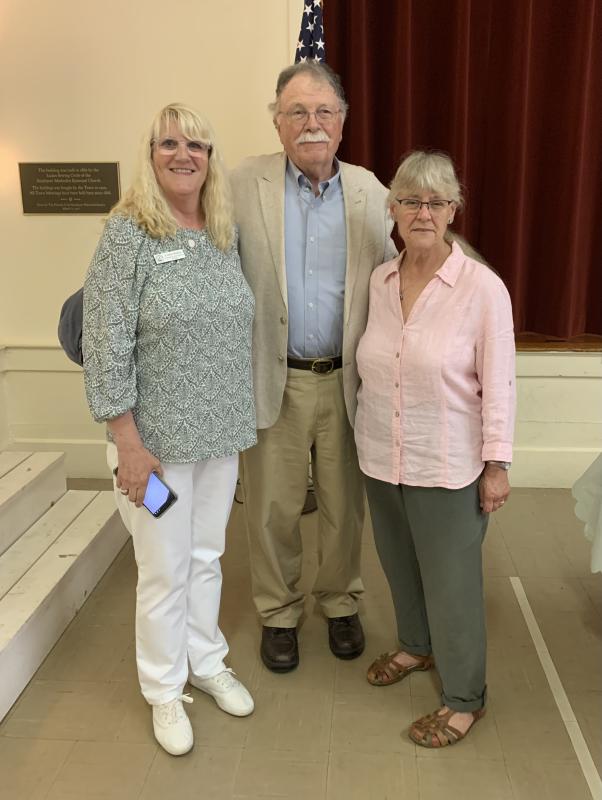 Boothbay Region Historical Society Outreach & Development Manager Connie Hartley, Don Carrigan and Mari Tiwari of Southport Historical Society. ISABELLE CURTIS/Boothbay Register
News Center Maine's Don Carrigan visits Southport Town Hall to share personal and professional insights with a packed house July 28. ISABELLE CURTIS/Boothbay Register
Boothbay Region Historical Society Outreach & Development Manager Connie Hartley, Don Carrigan and Mari Tiwari of Southport Historical Society. ISABELLE CURTIS/Boothbay Register
Boothbay Region Historical Society Outreach & Development Manager Connie Hartley, Don Carrigan and Mari Tiwari of Southport Historical Society. ISABELLE CURTIS/Boothbay Register
News Center Maine's Don Carrigan visits Southport Town Hall to share personal and professional insights with a packed house July 28. ISABELLE CURTIS/Boothbay Register
Boothbay Region Historical Society Outreach & Development Manager Connie Hartley, Don Carrigan and Mari Tiwari of Southport Historical Society. ISABELLE CURTIS/Boothbay RegisterA voice familiar to many Mainers graced Southport Town Hall July 28 as award-winning journalist and beloved co-host of News Center Maine's "207" Don Carrigan shared stories about growing up in the Midcoast and the evolution of news reporting. The event was co-sponsored by the Southport and Boothbay Region Historical Societies.
Raised in South Bristol, Carrigan had a childhood spent considering the Boothbay peninsula as foreign territory, an old-world, blue-collar neighborhood glimpsed through binoculars when his friends watched the first replica of 19th-century racing yacht America launch from Goudy & Stevens Shipyard in 1967, or later, as a rival to his high school, Lincoln Academy. So strong was the rivalry, Carrigan recalled classmates kept tire irons in their cars for post-basketball game fights, of which Carrigan was not a part.
Carrigan attended the University of Maine to pursue a degree in marine biology but was quickly disillusioned with upper-level science courses. Instead, his interest turned to WMEB 91.9, the university’s radio station, and broadcasting.
Not long after graduating, Carrigan took on a two-week unpaid gig at Bangor's WLBZ-TV filling in for a vacationing weatherman. Young, scared and the proud owner of only one suit jacket and two ties, he somehow made it through. Three weeks later, the station called him. "(They) said, ‘Well, we fired that guy, you want it?' So, I don't know if that was the idea to begin with, or not. But that's how I got started in TV."
Moving to Bangor was a revelation. For the first time, Carrigan was exposed to people of different races, religions and ethnicities, and, as a reporter, drove headfirst into understanding the new communities around him. Beyond that, there was also a world of industries, some now largely extinct: farms, coastal fisheries, shoe factories, textile plants and paper mills.
Carrigan said he may be looking at the past through rose-tinted glasses, but it seemed Maine once had an economy where people, even if they had very little education, could eke out a living for themselves and their families. Nowadays, not so much.
"I was lucky to be able to start working in Maine when the old Maine still existed."
Other changes Carrigan has seen are journalism’s technological evolutions. When he started in the early 1970s, news spots were shot on 16 millimeter film with 2 minutes and 47 seconds of storage. The larger model, usually used to film multiple segments, held 12 minutes. You learned not to ask very many questions during interviews, Carrigan said.
The footage was also black & white, contrasting sharply whenever it flipped from the color in-studio footage. "It looked like World War II."
The excitement when the switch was made to 20-minute capacity videotapes pales in comparison to the technology available now, when chips no bigger than a thumbnail can hold hours of material. Such strides are what allowed Carrigan to call in and later broadcast from home for the Stormcenter weather segments. That’s how his frequent guest, the 26-pound, orange Maine Coon Togus, named after the Augusta veterans hospital, became a local celebrity and star of his own children’s book. An equally large gray Maine Coon Rooski, named for his Russian birthplace, has taken up the mantle.
But the biggest evolution is the cellphone. User-submitted videos have not only become staples of major news networks, Carrigan has used his device to shoot “207."
This includes the New England Emmy-nominated “Monumental Mustard Move,” about Eastport volunteers who created a human chain to transport 33,000 jars of Raye’s Mustard—famous for its traditional grinding process using 125-year-old stones—to a storage facility while mill repairs are underway. The episode lost, but Carrigan holds two Emmys for 2015’s Maine gubernatorial candidate profile, "What Makes Them Run?" and 2023's “Lombard’s Genius,” about Maine native and inventor of the endless track Alvin Lombard.
Due to the amount of disheartening news on nightly television, "207" tends towards lighter fare. Carrigan and his team have control over what stories they tackle. One upcoming feature is on a group of men, all over 60, who build and drag race cars in Oxford.
However, sometimes "207" gets serious. Another forthcoming episode sees Carrigan return to Searsmont after the May fire and explosion at Robbins Lumber that resulted in three deaths. Carrigan previously did an episode at the mill to highlight the effect of President Trump's tariffs on the lumber industry between America and Canada. One of the people he interviewed, co-owner and vice president of Robbins Lumber Alden J. Robbins, was one of those who later died. Having known the family for four decades, Carrigan said the loss affected him personally.
“(But) the one thing that hasn't changed is that you still need people who are curious, people who pay attention, people who strive to be fair and honest in what they write and report and photograph … in hopes that a properly informed and educated public can then make a smart decision about what we are going to do.”