Stitching together a history of sailmaking
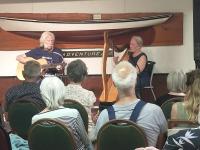
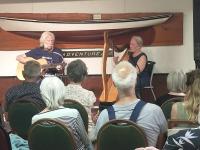
 Sailmaker Nat Wilson presents several tools of the trade during a talk at Boothbay Region Historical Society Feb. 18. FRITZ FREUDENBERGER/Boothbay Register
 A participant tries on a sailmakers sewing glove. FRITZ FREUDENBERGER/Boothbay Register
 The 1877 bark "Elissa" sailing into New York in 1986 with Nat Wilson's sails. Courtesy of Nat Wilson
 A cloth sail with hand stitching. FRITZ FREUDENBERGER/Boothbay Register
 A bronze cast tack iron on a new yacht sail. The fitting was fabricated by Paul E. Luke Inc to Wilson's design and installed on the sail by sailmakers at his loft. Courtesy of Nat Wilson
Sailmaker Nat Wilson presents several tools of the trade during a talk at Boothbay Region Historical Society Feb. 18. FRITZ FREUDENBERGER/Boothbay Register
A participant tries on a sailmakers sewing glove. FRITZ FREUDENBERGER/Boothbay Register
The 1877 bark "Elissa" sailing into New York in 1986 with Nat Wilson's sails. Courtesy of Nat Wilson
A cloth sail with hand stitching. FRITZ FREUDENBERGER/Boothbay Register
A bronze cast tack iron on a new yacht sail. The fitting was fabricated by Paul E. Luke Inc to Wilson's design and installed on the sail by sailmakers at his loft. Courtesy of Nat Wilson
A bronze cast tack iron on a new yacht sail. The fitting was fabricated by Paul E. Luke Inc to Wilson's design and installed on the sail by sailmakers at his loft. Courtesy of Nat Wilson
Sailmaker Nat Wilson presents several tools of the trade during a talk at Boothbay Region Historical Society Feb. 18. FRITZ FREUDENBERGER/Boothbay Register
A participant tries on a sailmakers sewing glove. FRITZ FREUDENBERGER/Boothbay Register
The 1877 bark "Elissa" sailing into New York in 1986 with Nat Wilson's sails. Courtesy of Nat Wilson
A cloth sail with hand stitching. FRITZ FREUDENBERGER/Boothbay Register
A bronze cast tack iron on a new yacht sail. The fitting was fabricated by Paul E. Luke Inc to Wilson's design and installed on the sail by sailmakers at his loft. Courtesy of Nat Wilson In the 1890s, sewing machines began to replace sailmakers due to their efficiency. By the end of World War II, commercial sailmaking was all but dead in the water. However, the craft didn’t disappear. Smaller operations embraced handcrafted sailmaking, stitching together traditional methods with creative innovations.
Longtime master craftsman Nat Wilson is one of those sailmakers. Wilson enlisted in the Coast Guard in the 1960s, where he began making sails for the service fleet, including the flagship Eagle. He continued learning traditional sailmaking at Mystic Seaport Museum. In 1975, he started a sail loft in East Boothbay, where he became renowned for his work on traditional and historical vessels.
Feb. 18, Wilson gave a talk at Boothbay Region Historical Society on sailmaking and its history in New England to a full crowd. With a focus on the Boothbay Region, Wilson recounted the story of sailmaking and the craftsmen who kept it alive. Vessels in the colonial period averaged around 50 tons, growing to hundreds of tons by the early 1900s, and thousands by the mid 19th century. The larger the ship, the greater the demands on sail designs.
Wilson said commercial sailmaking began in the mid-1800s in the Boothbay Region with the first sail loft in East Boothbay in 1848. It was a boom era for shipbuilding, with over 67 vessels constructed. The craftsmen were part of a lineage of master sailmakers and apprentices who worked in spacious lofts along the New England coast, designing and sewing the powerhouses of ships that sailed the Atlantic and beyond.
As technology advanced, the craft evolved. By the 1960s, sewing machines had long replaced hands for stitching, and synthetic fabrics had replaced cotton. Wilson provided samples of sailcloth, representative of a shift from heavy organic fabrics like cotton, flax and hemp to lighter synthetics. While large commercial operations opted for higher efficiency, craftsmen like Wilson kept traditions alive for historic ships and projects for discerning clients. However, sailmaking didn’t stay stagnant.
Wilson helped design a sailcloth widely used today on schooners and square-rigged vessels. “Oceanus” is an all-synthetic blend of monofilament and spun polyester that Wilson said has half the weight and twice the strength of cotton, adding that it is quiet, compressible and durable. Because it resembles a traditional sail, it is desirable for historical vessels. It is even on the Mayflower II, the reproduction of the ship that brought the pilgrims to Massachusetts in 1620. Wilson worked on the Mayflower II.
After a career making over thousands of sail plans and working on tens of thousands of sails, Wilson is his own living history of sailmaking. He will give an encore presentation of his talk on Feb. 25 at Boothbay Region Historical Society. Visitors can also learn more about sailmaking at the historical society through its collections of artifacts, photos and documents.