Lobsterman Finds Rare Arctic Gull
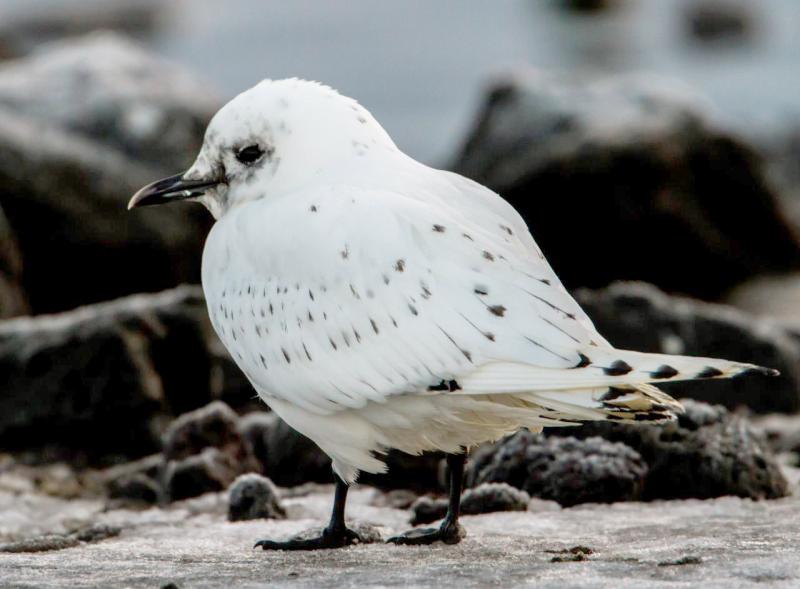 Ivory gulls are birds of Arctic extremes, very rarely coming south of northern New Foundland. A lobster fisherman found one on New Year's Day off the Maine coast. Wikimedia Commons courtesy of Omar Runolfsson.
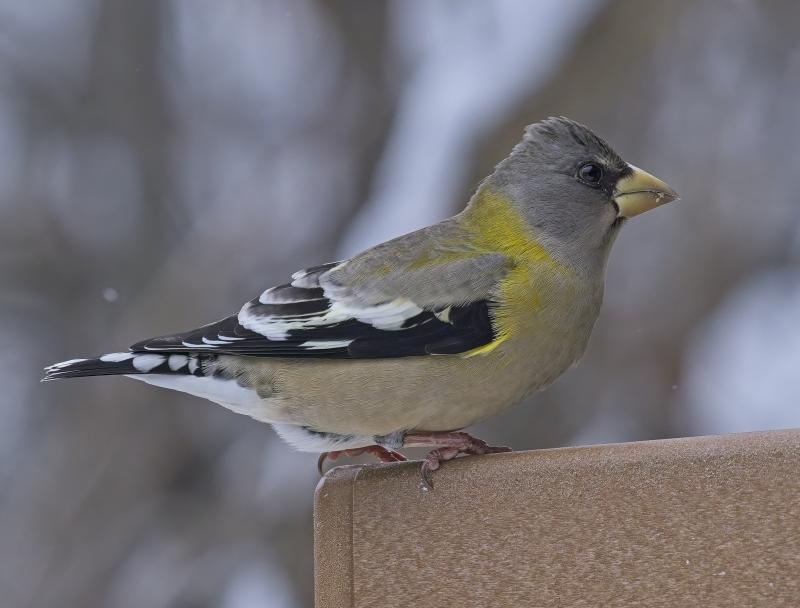 A female-plumaged evening grosbeak showed up in the authors' neighborhood recently, part of a wave of evening grosbeak sightings across the state. Wikimedia Commons courtesy of Mykola Swarnyck
Ivory gulls are birds of Arctic extremes, very rarely coming south of northern New Foundland. A lobster fisherman found one on New Year's Day off the Maine coast. Wikimedia Commons courtesy of Omar Runolfsson.
A female-plumaged evening grosbeak showed up in the authors' neighborhood recently, part of a wave of evening grosbeak sightings across the state. Wikimedia Commons courtesy of Mykola Swarnyck
A female-plumaged evening grosbeak showed up in the authors' neighborhood recently, part of a wave of evening grosbeak sightings across the state. Wikimedia Commons courtesy of Mykola Swarnyck
Ivory gulls are birds of Arctic extremes, very rarely coming south of northern New Foundland. A lobster fisherman found one on New Year's Day off the Maine coast. Wikimedia Commons courtesy of Omar Runolfsson.
A female-plumaged evening grosbeak showed up in the authors' neighborhood recently, part of a wave of evening grosbeak sightings across the state. Wikimedia Commons courtesy of Mykola SwarnyckIt’s shaping up to be one of those years where birds are pushed south by cold weather.
One example: This week we had the good fortune to have an evening grosbeak show up in our neighborhood. It seemed odd to see one of these normally gregarious birds by itself when they are almost always in flocks. Over these last weeks there have been an uptick in reports of flocks of evening grosbeaks across Maine’s Midcoast region.
You may recall we wrote back in November about the famed Winter Finch Forecast, which predicted a good showing of evening grosbeaks and other finches in the Northeast this winter. Until recently, the numbers were not particularly amazing, but perhaps this recent spate of cold weather has pushed more of them south, because this species is definitely forcing us now to take notice.
Another bird that may have been pushed south by the cold was found by a lobster fisherman offshore in Penobscot Bay on January 1st—the very rare ivory gull. Ivory gulls are small, all-white (immatures have black flecks in the white plumage) gulls that nest in the Arctic and tend to stay in or near the Arctic most winters. They feed in polynyas (areas that stay ice-free all winter) and on the remains of seals killed by polar bears or Inuit harvesters. Imagine being out lobstering and finding a bird like this!
Unfortunately, ivory gull numbers have plummeted, at least in the North American Arctic, so even fewer are likely to be found straying south here to Maine. This far south, the sighting of an ivory gull has always been exceptional, with fewer than 30 sightings since 1880. Interestingly, there is a museum specimen of one from Boothbay Harbor dated January 11, 1952.
Perhaps the most well-known and well-observed ivory gull was one that hung around Portland’s waterfront from mid-January to mid-March of 1997. Prior to the one seen this year, the last one reported in Maine was seen in late December 2020—interestingly, from a lobster boat offshore near Swan’s Island (between Stonington and Mount Desert Island).
We’ve only seen an ivory gull once and it was right here in Maine. One was found on Monhegan Island in late December 1986 and it stayed until early March 1987. Back then, the Laura B ferry traveled out from Port Clyde every other day in winter. We weren’t about to miss this bird, so off we went on a mid-February day. The crossing was one of the roughest we’ve ever experienced, with water sluicing into the back cabin, under our feet and out the scuppers. We were not going to stay over on the island so had just the thirty minutes or so that the boat would be unloading and loading at the dock to watch for the bird. Just before the boat was about to leave the bird flew past the dock and gave us some great, if fleeting, views.
Heading back to the mainland among the heaving seas, we attempted to leave the side doors open to keep the air circulating and thus minimize the risk of seasickness. Eventually, the waves were so wild we were forced to latch the doors shut and out came the seasickness bags. Despite one of us (Jeff, along with several other passengers!) having to put them to good use, the experience was well worth it—the gull was truly magnificent!
Maybe the ivory gull spotted on New Year’s Day will decide to find a spot on the mainland that’ll be a little easier on the stomach and delight a multitude of grateful birders. Keep your eyes open!
Jeffrey V. Wells, Ph.D., is a Fellow of the Cornell Lab of Ornithology and Vice President of Boreal Conservation for National Audubon. Dr. Wells is one of the nation's leading bird experts and conservation biologists. He is a coauthor of the seminal “Birds of Maine” book and author of the “Birder’s Conservation Handbook.” His grandfather, the late John Chase, was a columnist for the Boothbay Register for many years. Allison Childs Wells, formerly of the Cornell Lab of Ornithology, is a senior director at the Natural Resources Council of Maine, a nonprofit membership organization working statewide to protect the nature of Maine. Both are widely published natural history writers and are the authors of the popular books, “Maine’s Favorite Birds” (Down East Books) and “Birds of Aruba, Bonaire, and Curaçao: A Site and Field Guide,” (Cornell University Press).