A life and science of adaptation
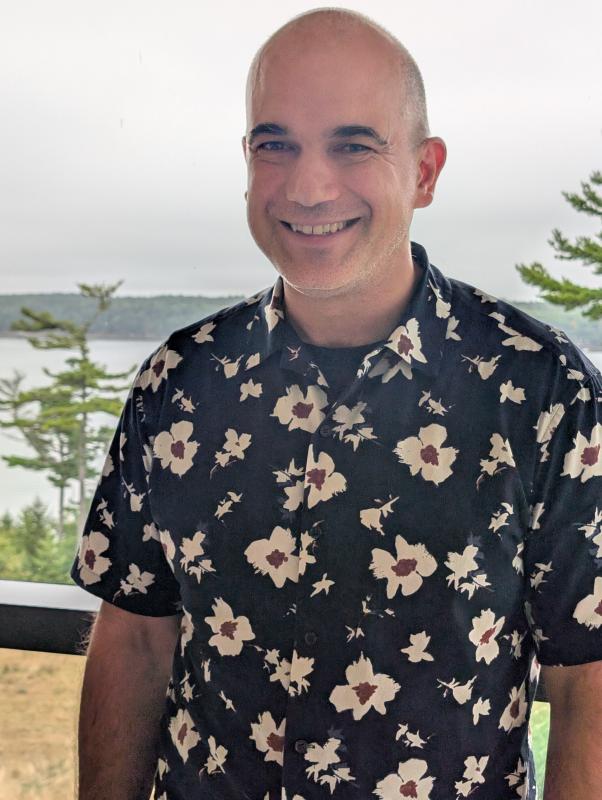 Senior Research Scientist John Burns. CANDI JONETH/Boothbay Register
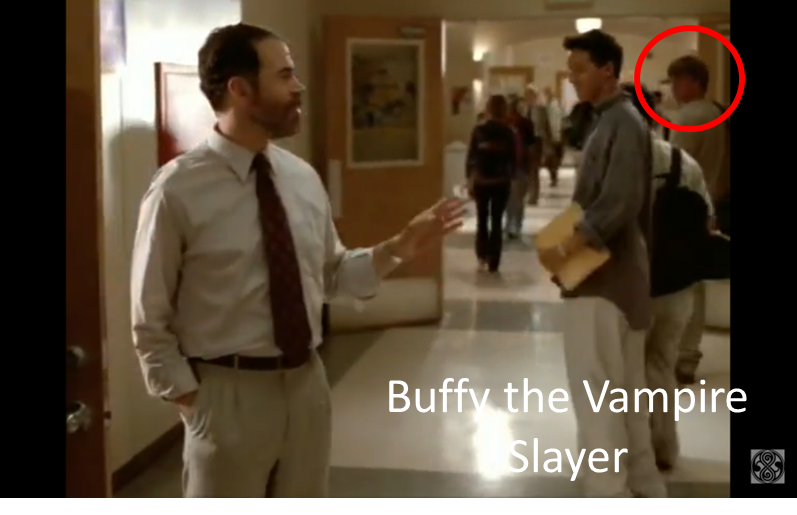 John Burns in "Buffy the Vampire Slayer." Courtesy photo
 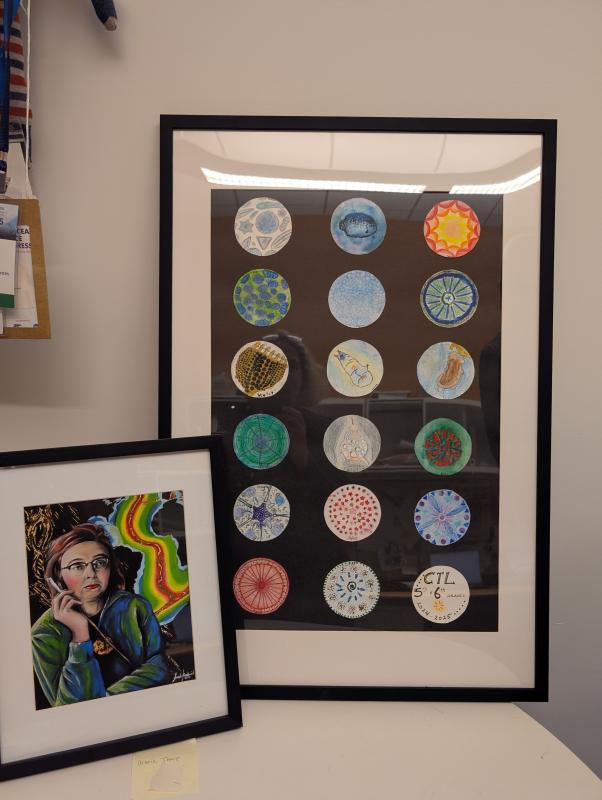 Left, a print of cartographer Marie Tharp, who produced the first scientific map of the Atlantic Ocean floor before modern technology. Right, a collection of radiolarian art from CTL students. CANDI JONETH/Boothbay Register
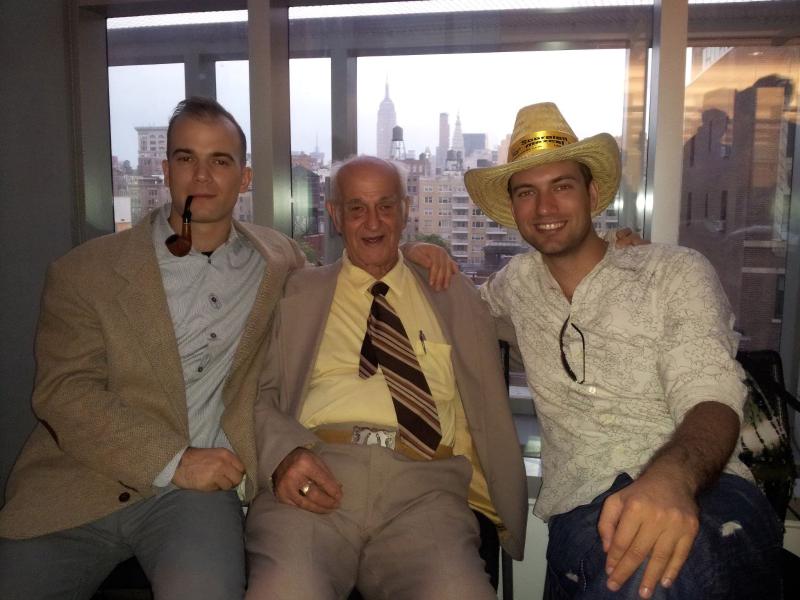 From left, John Burns, his grandfather John Halgas, and his brother William Burns celebrating Burns' defense of his PhD in 2012. Courtesy photo
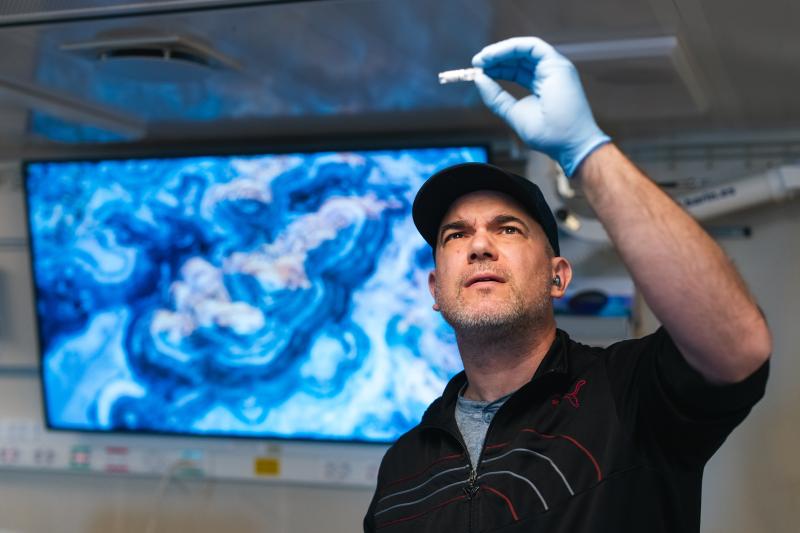 Photo by Alex Ingle, Schmidt Ocean Institute
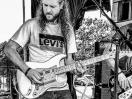
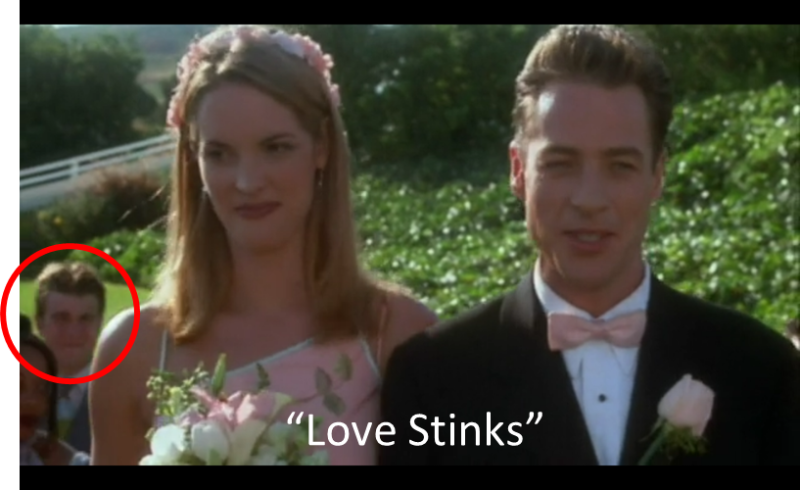 John Burns in "Love Stinks." Courtesy photo
Senior Research Scientist John Burns. CANDI JONETH/Boothbay Register
John Burns in "Buffy the Vampire Slayer." Courtesy photo
Left, a print of cartographer Marie Tharp, who produced the first scientific map of the Atlantic Ocean floor before modern technology. Right, a collection of radiolarian art from CTL students. CANDI JONETH/Boothbay Register
From left, John Burns, his grandfather John Halgas, and his brother William Burns celebrating Burns' defense of his PhD in 2012. Courtesy photo
Photo by Alex Ingle, Schmidt Ocean Institute
John Burns in "Love Stinks." Courtesy photo
John Burns in "Love Stinks." Courtesy photo
Senior Research Scientist John Burns. CANDI JONETH/Boothbay Register
John Burns in "Buffy the Vampire Slayer." Courtesy photo
Left, a print of cartographer Marie Tharp, who produced the first scientific map of the Atlantic Ocean floor before modern technology. Right, a collection of radiolarian art from CTL students. CANDI JONETH/Boothbay Register
From left, John Burns, his grandfather John Halgas, and his brother William Burns celebrating Burns' defense of his PhD in 2012. Courtesy photo
Photo by Alex Ingle, Schmidt Ocean Institute
John Burns in "Love Stinks." Courtesy photoWhile many evolutionary biologists trace their passion to an early childhood love for dinosaurs, Senior Research Scientist John Burns of Bigelow Laboratory for Ocean Sciences (BLOS) followed a less linear trajectory. He did not take a single biology class during his undergraduate years, and his doctorate focused on human cancer. Yet for Burns, molecular biology is fundamentally about experimentation, reassessment and adaptation—a mindset that perfectly reflects his own circuitous journey through the sciences. Today, his diverse toolkit, honed through several multidisciplinary routes, enables him to investigate nearly everything, combining genomics and classic biology to uncover both evolutionary and mechanistic behaviors, from the smallest molecular level to the largest ecological scales.
But first: Hollywood.
Burns has always wanted to be a chemist, but he struggled to stay academically engaged during his first year of undergraduate studies. After receiving an academic suspension, he wrote his college a letter requesting a break. He and his savings, about $800, went to Los Angeles, hoping to gain practical experience as a bench chemist. When temp agencies did not hire him, he ran out of money and spent time sleeping in his “old junk car.” Then, meals became sparse. "I don't want to sound as if I was unsupported. I knew my parents had my back. I just needed to figure out how to do things my own way," he said.
Burns worked any odd job he could, but his struggles were substantial. He knew the pains of hunger. And like so many Hollywood stories, when life looked bleak, Burns finally got a break working for a casting director. Soon, he found steady work as a television and film extra, earning $65 a day, crashing on friends' couches at night. It was a job he was attracted to, in part, because there were always free catered meals on the sets. He pawned his computer to pay for headshots. He famously joked that while everyone in LA wanted to be a movie star, he just wanted to be a chemist.
Returning to college with renewed motivation, he took courses in philosophy and Russian literature and switched his major to geology after observing that the geology professors seemed to have the most fun with their field studies and their muddy boots. Following graduation, Burns interned at the National Aeronautic and Space Administration (NASA), where he helped map the surface of Mars and, while at the U.S. Geological Survey, he studied groundwater arsenic in Maine. Burns enjoyed the stability of a good science job, but he eventually realized he didn’t want to spend his career answering someone else’s scientific inquiries. He had questions of his own.
Seeking a change, Burns moved to Alabama, took a job as a cook, and spent months rebuilding a 1972 28-foot sailboat with a college roommate. The pair sailed the vessel to the Florida Keys, encountering bioluminescent algae and dolphins along the way. He wasn’t aware at the time, but those beautiful seascapes he relished from his life on the water were becoming another tool in his toolbox.
In Florida, Burns received news that his younger brother had been diagnosed with cancer. Shocked to realize he knew virtually nothing about cancer or how it worked, Burns resolved to learn everything he could about the disease. A friend's father encouraged him to become a molecular biologist, and Burns began cold-calling graduate programs. It was going to be a tough sell, given he hadn’t had a single biology class. "Edward Beutner, a geoscience professor from Franklin and Marshall College, I'll never forget how he wrote a letter of recommendation for me from his hospital bed to help me get into the PhD program at NYU." (New York University) Professor Christine Rushlow offered him a chance: If he excelled in a summer introductory biology course, she would admit him into the master's program. Burns passed the course. "I started the PhD in 2008, the same year he (Beutner) died of lymphoma."
Burns received a lab job to cover NYU's tuition, and he earned a PhD studying DNA repair mechanisms and cancer mutations. “There are a lot of very smart, very dedicated people in cancer research,” said Burns. “At times, the pressures of the PhD track would take their toll, but I was always able to think about those mental images I had from living on the boat. I could Zen-out when it became too much. I carry those pictures in my head still today,” said Burns. Burns’ brother made a full recovery following surgery and chemotherapy.
Despite Burns' success in cancer research, he was drawn to broader, exploratory questions. He completed a postdoctoral fellowship at the American Museum of Natural History, but he never got an image out of his mind: radiolarians— intricate single-celled marine protists with glass-like skeletons he had learned about in geology.
Burns was determined to take a month off in New York City. He planned to celebrate his doctoral completion, taking in the many forms of entertainment the city offers. Instead, that month turned into a few days’ notice to join a sampling expedition in Norway’s fjords. What were they sampling? Radiolarians.
In his office at BLOS, Burns proudly displays twisty, spiraled and webbed, geometric shapes of radiolarian art made by the Center for Teaching and Learning fifth and sixth-grade students. “Of course, I had to bid on it,” said Burns. He mentors high school and graduate students, placing tremendous importance on supporting the next generation of scientists. Following his interview with the Register, Burns flew to NYU to serve on a career panel for future discoverers. He shares his own winding story to reassure young scientists that exploring broad, varied interests can be a profound strength rather than a distraction. "I met my partner/wife when I was living in the Florida Keys and we were together through both of our graduate educations. She is from Poland and got a bachelor's and master's from Hunter College in NYC in social work. She was doing that during the same period that I was getting my master's and PhD. She helped keep me grounded through everything it takes to get the degree. Hopefully I helped her, too."
For Burns, the primary thrill of science is not the output of discovery, but the daily joy of learning something new, of asking new questions.
Burns discovered 31 new species in just two weeks of exploration in the South Atlantic Ocean’s midwater range earlier this year, and identified a billion-year-old microbial lineage related to Breviatea in Edgecomb’s mudflats— a discovery some call a missing link.
Burns is not done seeking answers. He is deeply curious about how cells process environmental signals and translate genetic code into physical form. He is particularly drawn to "outliers" on the tree of life, believing that solving unique biological puzzles reveals general principles applicable across all living systems. Among his positions, he advocates for a re-evaluation of how science classifies biodiversity. Noting that plants and animals only diverged around 500 million years ago, he has pitched to fellow researchers that the vast, ancient diversity of single-celled protists warrants recognizing at least 55 distinct kingdoms of life.
In Burns’ case, scientific pursuit and life itself seem to model each other; full of exploration, discovery of novel approaches, fresh insights into long-standing lineages and boundless curiosity. He is a reminder that while linear paths are considered efficient, there is beauty in shaping one’s life more like a radiolarian.