Grace Campbell digs the past
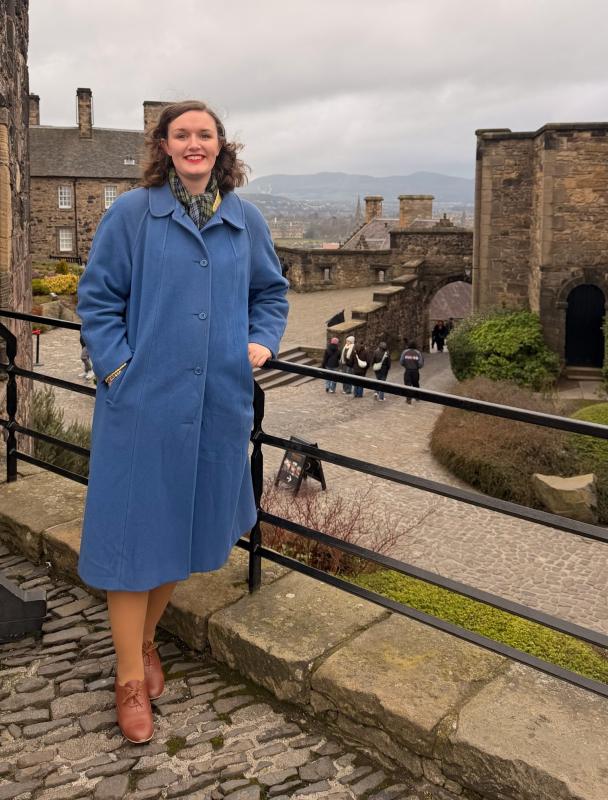 BRHS alum Grace Campbell is spending part of her junior year in Edinburgh, Scotland, to learn more about archaeological field work. Courtesy of Grace Campbell
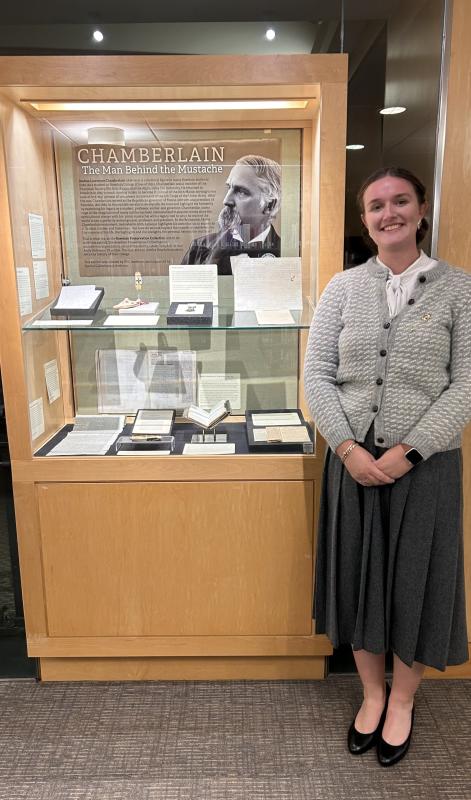 Campbell with the “Chamberlain: The Man Behind the Moustache" exhibition. Courtesy of Grace Campbell
BRHS alum Grace Campbell is spending part of her junior year in Edinburgh, Scotland, to learn more about archaeological field work. Courtesy of Grace Campbell
Campbell with the “Chamberlain: The Man Behind the Moustache" exhibition. Courtesy of Grace Campbell
Campbell with the “Chamberlain: The Man Behind the Moustache" exhibition. Courtesy of Grace Campbell
BRHS alum Grace Campbell is spending part of her junior year in Edinburgh, Scotland, to learn more about archaeological field work. Courtesy of Grace Campbell
Campbell with the “Chamberlain: The Man Behind the Moustache" exhibition. Courtesy of Grace CampbellWhen it comes to history and archaeology, dual major Grace Campbell’s chosen field of study, she’s heard it all before, from fellow students in her Boothbay Region High School days: That it is all memorization, and how could she even be interested.
Campbell’s answer is multifold. History can be much more than fact and date recall. There are human stories housed in the narratives and material items of the past, whether it's pottery fragments, letters home from the warfront, or 3,000-year-old Assyrian reliefs. There’s also the infectious passion of educators. Campbell has firsthand experience of this, recalling how she walked into an Egyptian archaeology course taught by Bowdoin College Professor Jim Higginbotham to fill a gap in her schedule and left with an additional major.
“And for me, I want to do history because I want to make it exciting,” Campbell said.
Campbell is a believer in what she calls “public history,” aka making the subject accessible to all. With the rising cost of college, the bar of entry to education is high, especially in the U.S., she explained. The world of academia is also insular, with the cost of museum entry or access to academic articles often too high for the general public, who don’t have those fees waived by a university as students do.
These conditions were among the inspirations for “The Bowdoin Preservation Collective,” a club Campbell helped found that offers walking tours for admitted students and faculty about the college’s history. The collective was behind a recent exhibit on Joshua Chamberlain, former Maine governor, Civil War veteran and Bowdoin president (1871-1883), entitled “Chamberlain: The Man Behind the Moustache.”
The goal of the exhibit was to cast a humanizing light on the man whose statue presides over Main Street in Brunswick. One artifact is a letter to his young daughter, written in purple ink in print script because she was too young to read the era’s typical cursive. The contents include assurances that the rebels are being taught a lesson and hopes that the weather conditions in Maine are better than what Chamberlain is experiencing. Not long after this letter, Chamberlain was put in charge of the 20th Maine Volunteer Infantry Regiment and eventually fought in the Battle of Gettysburg.
“It's a very pleasant letter to read, but ... it's interesting to think about everything surrounding that letter that he just isn't telling his daughter, because she's 5 and can't comprehend it. It (shows) the humanity behind him.”
At Bowdoin, Campbell is known as “the Joshua Chamberlain girl,” a label she doesn't dispute. One of her favorite school experiences was cleaning Chamberlain's house with her club. Turns out she shares Chamberlain's shoe size. Some of her first friends at the school were also made through a shared interest in the man, and it became an exam good luck ritual for some to make a pilgrimage to his grave and leave a token.
It doesn't hurt that Chamberlain falls into Campbell’s preestablished love of the American Civil War. She traces her lineage to Civil War veterans, including her many times great-grandfather, Leonard Webster, and his brother, Lorenzo Webster, who was at Gettysburg. Campbell will be working at Gettysburg National Military Park this summer.
While the Civil War has not been dethroned as a favorite historical period, Campbell has expanded her interests, in part due to her archaeology work. The history major mostly focuses on the medieval period onward through narratives, while archaeology concentrates on material objects from ancient Mediterranean civilizations and the western Middle East.
“It's a very hand-in-hand kind of concentration to be doing.”
Roman Spain has caught her interest as a less-discussed melting pot, with artifacts showing the influence of the Phoenicians, Celts, and Greeks on one another. Campbell explained that archaeology in Spain was neglected until recent years, as early archaeologists were more interested in Egypt and Pompeii. “They're discovering new things (in Spain) every day.”
Campbell is currently in Edinburgh, Scotland, for a one-semester study abroad program, where she is taking an archaeology-in-action training course that covers fieldwork, health and safety, and lab analysis. She will receive a certificate (archaeology passport) at the end, which will allow her to work on some dig sites.
“It's something that Bowdoin doesn't offer because it's a smaller base, and they don't have many archeology majors.”
Technically, Bowdoin doesn't have an archaeology major; rather, it's a concentration in the classics major. Campbell could take classics and Latin classes to meet the requirements, but that doesn’t give her the hands-on experience that her fellow students who can afford to attend archeological summer camps do.
“I feel like studying abroad has given me the opportunity to develop (my archaeological studies) further in a way that is accessible.”
As a junior, Campbell still has another year left at Bowdoin, but she has her eyes set on grad school, with a PhD down the line. She wants to work in museum curation.