A Cool Bird Adventure on a Hot Day in Maine
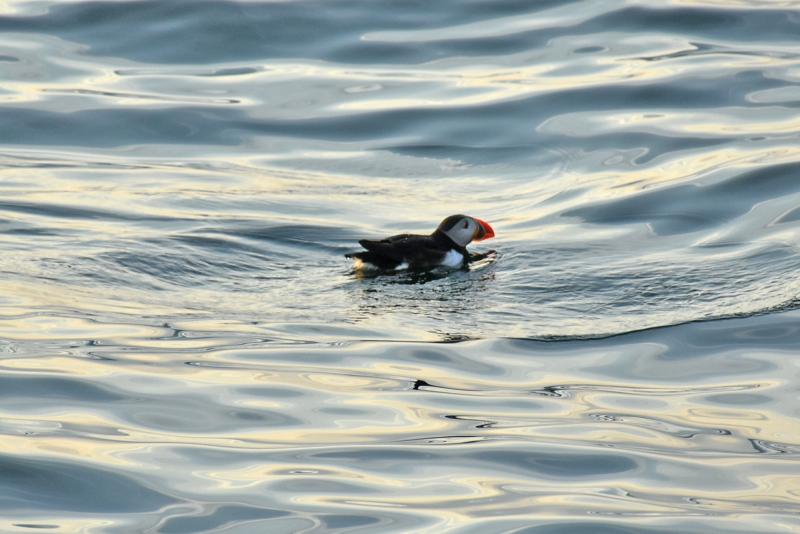 There are few activities as enjoyable as watching puffins off the coast of Maine on a hot summer evening, especially with members of the Natural Resources Council of Maine. (B Comeau/NRCM)
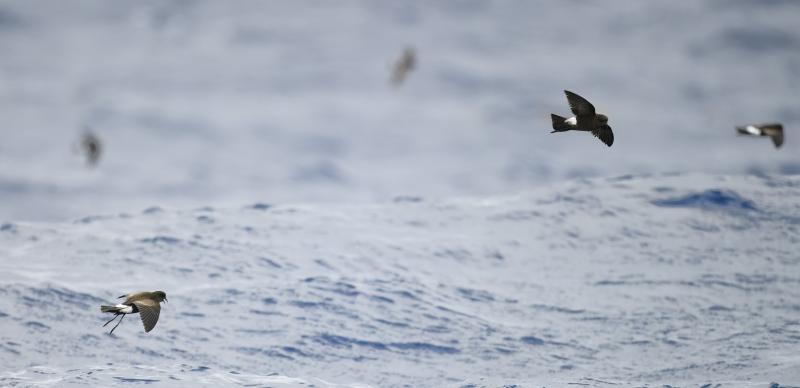 Adding to the adventure: spying Wilson's storm-petrels from the Hardy Boat on the way out to Eastern Egg Rock as well as on the way back to New Harbor. Photo by lwolfartist couresty of Wikimedia Commons.
 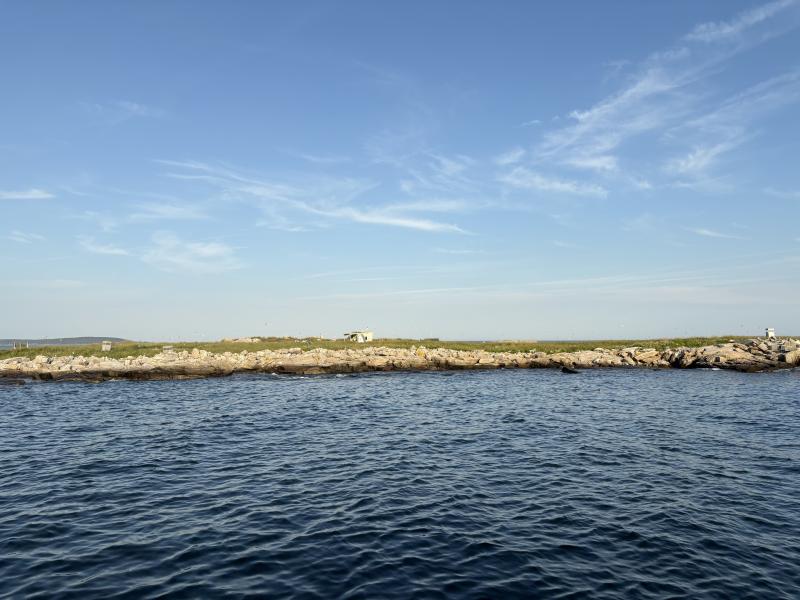 The low-lying island of Eastern Egg Rock, where, thanks to the efforts of Dr. Steve Kress and National Audubon's Seabird Institute, Atlantic puffins now once again breed in abundance, along with a cacophony of terns. Courtesy of Jeff Wells.
There are few activities as enjoyable as watching puffins off the coast of Maine on a hot summer evening, especially with members of the Natural Resources Council of Maine. (B Comeau/NRCM)
Adding to the adventure: spying Wilson's storm-petrels from the Hardy Boat on the way out to Eastern Egg Rock as well as on the way back to New Harbor. Photo by lwolfartist couresty of Wikimedia Commons.
The low-lying island of Eastern Egg Rock, where, thanks to the efforts of Dr. Steve Kress and National Audubon's Seabird Institute, Atlantic puffins now once again breed in abundance, along with a cacophony of terns. Courtesy of Jeff Wells.
The low-lying island of Eastern Egg Rock, where, thanks to the efforts of Dr. Steve Kress and National Audubon's Seabird Institute, Atlantic puffins now once again breed in abundance, along with a cacophony of terns. Courtesy of Jeff Wells.
There are few activities as enjoyable as watching puffins off the coast of Maine on a hot summer evening, especially with members of the Natural Resources Council of Maine. (B Comeau/NRCM)
Adding to the adventure: spying Wilson's storm-petrels from the Hardy Boat on the way out to Eastern Egg Rock as well as on the way back to New Harbor. Photo by lwolfartist couresty of Wikimedia Commons.
The low-lying island of Eastern Egg Rock, where, thanks to the efforts of Dr. Steve Kress and National Audubon's Seabird Institute, Atlantic puffins now once again breed in abundance, along with a cacophony of terns. Courtesy of Jeff Wells.
There are few better places to be on a torridly hot summer day than the cool ocean waters off the Maine coast. That’s where we found ourselves a few weeks ago during one of those near record-breaking hot days.
We were on the upper deck of the Hardy Boat out of New Harbor for the annual Natural Resources Council (NRCM) of Maine puffin trip to Eastern Egg Rock. Long-time friend Steve Kress (the “prince of puffins”) and his wife Elissa were onboard, Steve providing his colorful narrative describing his story about his half-century long project restoring puffins to Eastern Egg Rock. It was our pleasure to assist Steve in pointing out and identifying the many bird species we saw. Justin Strasberger, the new head of NRCM was there, too, talking with members, showcasing his boundless energy and enthusiasm for protecting Maine’s environment.
But the birds were the real show. Streams of common terns passed by the boat even as we left New Harbor, heading to and from our island destination, their black caps, red bills (with a little black tip) and long, forked tails looking as elegant as ever. About a quarter of a mile from land, we finally moved out of the bubble of hot air streaming off the mainland and felt the temperature drop to a slightly more comfortable coolness.
A single common loon in full breeding plumage, with its black head and checkered back, sat on the water. Was it a failed breeding bird that fled to the ocean to escape the heat, or an individual that had just decided not to leave after a winter spent on the coast?
Low over the water in the distance we spied a small swallow-like bird, brown with a white rump, darting about, then occasionally fluttering over the water’s surface, then another, and another. Hard to fathom that these Wilson’s storm-petrels were seabirds that nested on Sub Antarctic islands during our winters (when its summer in the Southern Hemisphere) and then made the seven- to ten-thousand-mile journey to hang out here in the Gulf of Maine.
And then suddenly we there at Eastern Egg Rock.
It’s really a rather tiny and flat island—about seven acres in size. Its highest point is less than 20 feet above sea level but it is covered in birds! A couple of small structures are found on one side, there to house the small National Audubon Society research team that monitors and studies the birds all summer. They affectionately refer to the ramshackle building as the Egg Rock Hilton. We waved and they waved back.
Over the island, thousands of terns, mostly common terns but a few of the whiter and long-tailed roseate terns and the hard-to-pick out Arctic terns, swirled and called in a cacophonous bird symphony. The first puffin to come flying in and land a hundred yards from the boat caused a momentary pandemonium of excitement. But soon there were puffins all around, sometimes in groups of five or ten or more, their orange-and-yellow beaks gleaming. Others flew right onto the island carrying fish to take down into their burrows deep in the jumbled rocks along the edges.
At one point a shout of “razorbill” rose from someone behind us. Sure enough, there was the snazzy black-and-white plumed relative of the puffin that some think of as looking like a tiny penguin (though they are totally unrelated). Steve Kress broke the exciting news that a pair of razorbills nested on Eastern Egg Rock for the first time this summer!
An American oystercatcher popped up on a dark-seaweed covered ledge, showing off its long, orange bill. Black guillemots buzzed by, showing off the white wing patches on their otherwise black bodies. Little groups of female common eiders corralled half-grown chicks bobbing in the waves near the shore.
By the time the boat captain announced it was time to head back to New Harbor, we all felt fulfilled. The setting sun glinting off the calm waters made the trip back seem magical, with the bell buoy clanging gently as we neared the harbor entrance.
We are already looking forward to next year.
Jeffrey V. Wells, Ph.D., is a Fellow of the Cornell Lab of Ornithology and Vice President of Boreal Conservation for National Audubon. Dr. Wells is one of the nation's leading bird experts and conservation biologists. He is a coauthor of the seminal “Birds of Maine” book and author of the “Birder’s Conservation Handbook.” His grandfather, the late John Chase, was a columnist for the Boothbay Register for many years. Allison Childs Wells, formerly of the Cornell Lab of Ornithology, is a senior director at the Natural Resources Council of Maine, a nonprofit membership organization working statewide to protect the nature of Maine. Both are widely published natural history writers and are the authors of the popular books, “Maine’s Favorite Birds” (Down East Books) and “Birds of Aruba, Bonaire, and Curaçao: A Site and Field Guide,” (Cornell University Press).