What Do These Three Rare Birds Have in Common?
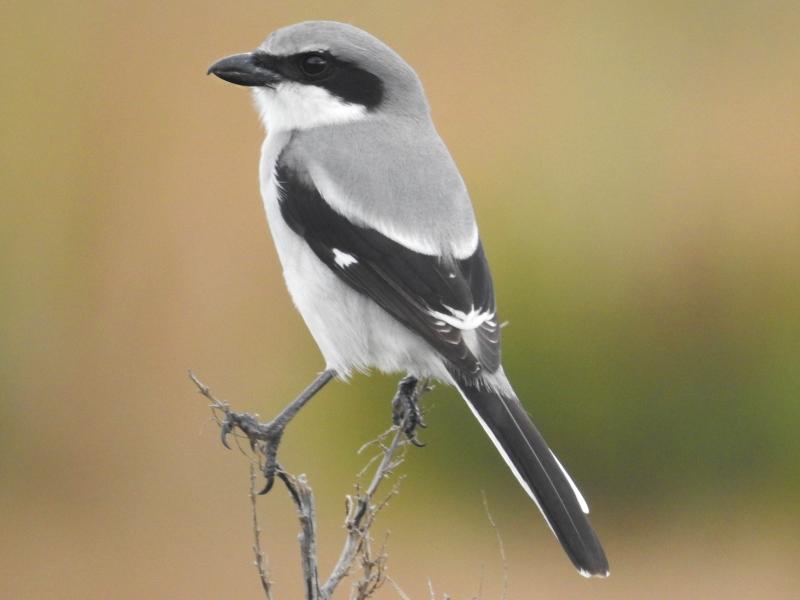 Like its more-common-to-Maine (in winter) northern cousin, the northern shrike, the loggerhead shrike captures small mammals and insects (and occasionally small birds) and often impales them on thorns and twigs so it can more easily tear into them for eating. Photo by Jeffrey Gammon courtesy of Wikimedia Commons
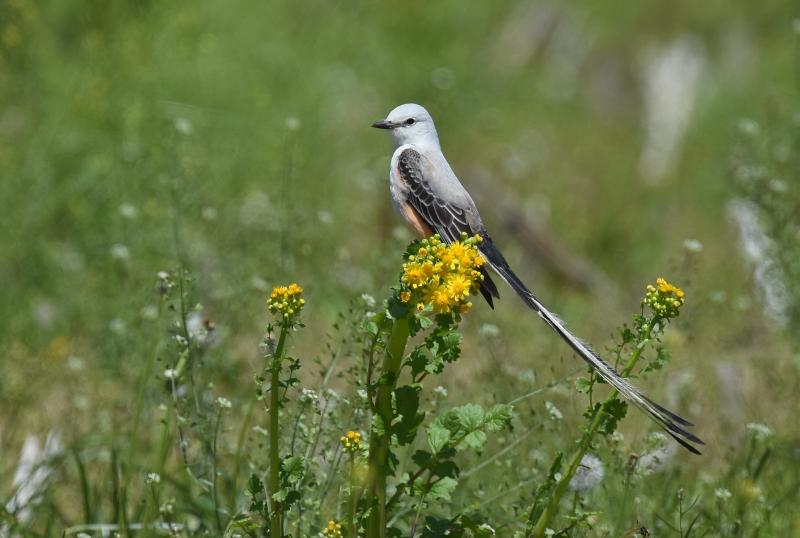 With its long, forked tail, the appropriately named scissor-tailed flycatcher is a striking bird in the open lands of its breeding range from northern Mexico across Texas and north to Kansas. Several have been sighted in Maine this spring and early summer. Photo by Andy Reago and Chrissy McClarren, courtesy of Wikimedia Commons
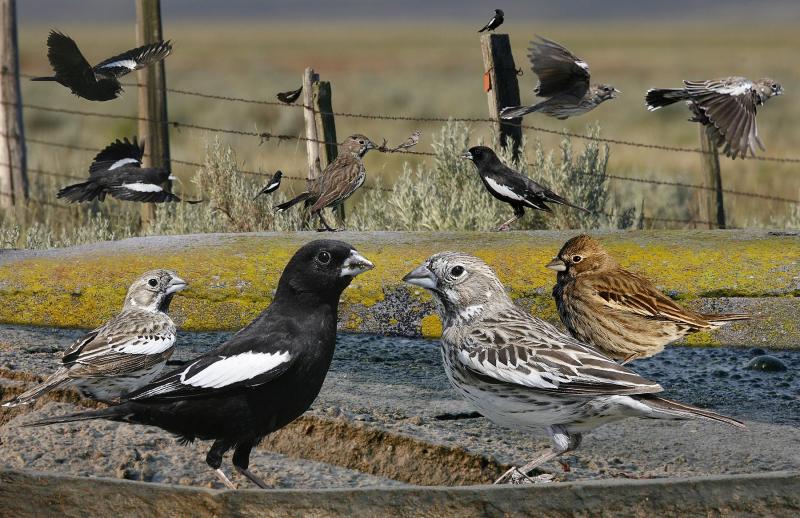 Lark buntings are very rarely detected in Maine. This graphic, from the "Crossley ID Guide to Eastern Birds," shows males, females, and immature birds in their typical rangeland habitat in the Midwest. A female-plumaged bird was found and photographed as it fed on dandelion seeds at the Bar Harbor Airport on June 1. Image by Richard Crossley, courtesy Wikimedia Commons
Like its more-common-to-Maine (in winter) northern cousin, the northern shrike, the loggerhead shrike captures small mammals and insects (and occasionally small birds) and often impales them on thorns and twigs so it can more easily tear into them for eating. Photo by Jeffrey Gammon courtesy of Wikimedia Commons
With its long, forked tail, the appropriately named scissor-tailed flycatcher is a striking bird in the open lands of its breeding range from northern Mexico across Texas and north to Kansas. Several have been sighted in Maine this spring and early summer. Photo by Andy Reago and Chrissy McClarren, courtesy of Wikimedia Commons
Lark buntings are very rarely detected in Maine. This graphic, from the "Crossley ID Guide to Eastern Birds," shows males, females, and immature birds in their typical rangeland habitat in the Midwest. A female-plumaged bird was found and photographed as it fed on dandelion seeds at the Bar Harbor Airport on June 1. Image by Richard Crossley, courtesy Wikimedia Commons
Lark buntings are very rarely detected in Maine. This graphic, from the "Crossley ID Guide to Eastern Birds," shows males, females, and immature birds in their typical rangeland habitat in the Midwest. A female-plumaged bird was found and photographed as it fed on dandelion seeds at the Bar Harbor Airport on June 1. Image by Richard Crossley, courtesy Wikimedia Commons
Like its more-common-to-Maine (in winter) northern cousin, the northern shrike, the loggerhead shrike captures small mammals and insects (and occasionally small birds) and often impales them on thorns and twigs so it can more easily tear into them for eating. Photo by Jeffrey Gammon courtesy of Wikimedia Commons
With its long, forked tail, the appropriately named scissor-tailed flycatcher is a striking bird in the open lands of its breeding range from northern Mexico across Texas and north to Kansas. Several have been sighted in Maine this spring and early summer. Photo by Andy Reago and Chrissy McClarren, courtesy of Wikimedia Commons
Lark buntings are very rarely detected in Maine. This graphic, from the "Crossley ID Guide to Eastern Birds," shows males, females, and immature birds in their typical rangeland habitat in the Midwest. A female-plumaged bird was found and photographed as it fed on dandelion seeds at the Bar Harbor Airport on June 1. Image by Richard Crossley, courtesy Wikimedia CommonsThere’s no doubt that we birders find a thrill in seeing rare birds—birds from somewhere else that make their way to wherever we are (in our case, Maine) unexpectedly. Why they come our way is often mysterious, but one thing is certain: The fewer the number of individuals that make up a species, the fewer there are that should be available to wander from their normal range.
This is why we find it curious that there has been an apparent uptick in the number of loggerhead shrikes found in here Maine in the last few years. Don’t get us wrong; a sighting of a loggerhead shrike in Maine is still very rare (though they did nest in the state until at least 1975, as we wrote in a 2024 column. Yet loggerhead shrikes have been declining across their North American range for decades.
This spring there have been loggerhead shrike sightings from Matinicus Rock and also from Monhegan Island (the last sighting there was 25 years ago!). Was it the same bird? Possibly, since the bird was spotted on Matinicus Rock on June 1st and Monhegan Island on June 7th. There were two sightings of the species in Massachusetts in two locations hundreds of miles apart in May as well. It’s hard for us to believe that all of these sightings could represent the same bird. But…maybe.
The most migratory populations of the loggerhead shrike are the ones that nest in the Midwest north from Nebraska and Iowa into southern Alberta, Saskatchewan, and Manitoba. The birds largely vacate that part of the range in winter, heading farther south in the U.S. and into Mexico.
Is it a coincidence, we wonder, that at the same time as one or more loggerhead shrikes have appeared, Maine has also been graced with two other species whose ranges are in the Midwest? A lark bunting delighted birders at the Bar Harbor airport in Trenton on the same day that the loggerhead shrike was photographed on Matinicus Rock. If you don’t know the lark bunting, don’t feel bad. Lark buntings are normally found this time of year in a strip of grasslands from southern Alberta and Saskatchewan south to northern Texas.
The most elegant of flycatchers, in our opinion at least, is the scissor-tailed flycatcher. One of these beautiful birds was spotted on Mount Desert Island on June 6 and perhaps another was found (as we were writing this on June 8) at the Bowdoin Sand Plains in Brunswick.
Yup, this is another bird of the Midwest, breeding from northern Mexico through Texas to Kansas and Missouri.
What would have caused three species, arguably from the same geographic area, to end up in Maine at the same time? It seems late for migrants to have been swept up in a weather system that blew them into the state. Could they be birds that found drought or some other bad conditions on the breeding grounds that sent them wandering? Will some other rare bird from that geography show up? A western meadowlark, perhaps? If so, we hope it will be singing, since it’s extremely difficult to distinguish them from “our” eastern meadowlark except by voice.
What an exciting time to be birding in Maine!
Jeffrey V. Wells, Ph.D., is a Fellow of the Cornell Lab of Ornithology and Vice President of Boreal Conservation for National Audubon. Dr. Wells is one of the nation's leading bird experts and conservation biologists. He is a coauthor of the seminal “Birds of Maine” book and author of the “Birder’s Conservation Handbook.” His grandfather, the late John Chase, was a columnist for the Boothbay Register for many years. Allison Childs Wells, formerly of the Cornell Lab of Ornithology, is Senior Director of Communications at the Natural Resources Council of Maine, a nonprofit membership organization working statewide to protect the nature of Maine. Both are widely published natural history writers and are the authors of the popular books, “Maine’s Favorite Birds” (Down East Books) and “Birds of Aruba, Bonaire, and Curaçao: A Site and Field Guide,” (Cornell University Press).