Discussions stall at BBHWP public hearing
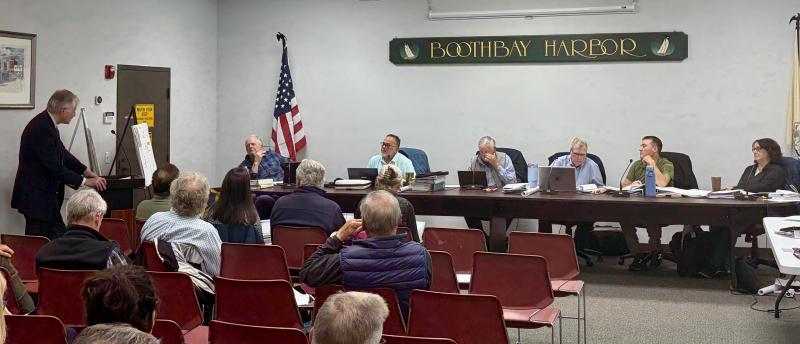 Anthony Muri speaks to the Boothbay Harbor Planning Board Sept. 28. ISABELLE CURTIS/Boothbay Register
Anthony Muri speaks to the Boothbay Harbor Planning Board Sept. 28. ISABELLE CURTIS/Boothbay Register
Anthony Muri speaks to the Boothbay Harbor Planning Board Sept. 28. ISABELLE CURTIS/Boothbay Register
Sept. 28, the public merit review hearing for Boothbay Harbor Waterfront Preservation (BBHWP)'s amended site plan application took a detour to address issues raised by project abutters. Concerns were presented to Boothbay Harbor's planning board in two Sept. 24 communications.
During the Aug. 26 meeting, the board denied BBHWP’s request to install a subsurface wastewater disposal system for the splashpad, saying that the park must connect to public sewer per ordinance. According to a meeting document, the abutter’s argued that this denial is grounds for the rejection of the entire amended site plan review application.
Kristin Collins, the abutter’s lawyer, explained the current BBHWP application reflects the proposed subsurface disposal system, not the required municipal sewer hookup and relevant utility plans, so proceedings should pause until a new site plan is created. She also advocated for this option rather than a sewer hookup as a condition of approval.
“I just don't think that (the board’s authority to attach conditions) covers this kind of situation where the application on its face doesn't meet the standard,” she said.
The status of BBHWP’s National Resources Protection Act (NPRA) permit from Maine Department of Environmental Protection (DEP) was also questioned, as the latest approval was for the subsurface disposal system. Mitch Rasor of Rasor Landscape Architecture, who handles BBHWP’s permitting, said a prior iteration of the NRPA permit covered going into the sewer.
The board voted unanimously that BBHWP is required to connect to the public sewer (for the disposal of wastewater only) as a condition of any approval of its amended application and that, prior to final approval, it obtain all required permits, including an updated NRPA permit or confirmation that a new permit is not needed.
In other business, the possible expiration of BBHWP’s 2020 site plan review is back on the table. In July, the board decided that determining expiration was outside its authority and asked the interim Code Enforcement Officer (CEO) Dan Feeney for a ruling.
However, the deadlines were unable to be met. In a Sept. 17 letter to BBHWP lawyer Anthony Muri, Feeney expressed the need for “additional, project-specific information concerning actual expenditures and the corresponding approved project scope before a determination can be made.” Feeney’s appointment as interim CEO has since ended.
Abutters argued in their petition that the planning board has the needed information to resolve the expiration question and that the past two CEOs who have examined the issue did not have enough information because BBHWP did not meet its burden of proof to show timely substantial start or completed work.
Muri said expiration was not in the board’s jurisdiction and that, while BBHWP is obligated to provide evidence of what it's done, the burden of persuasion is on the abutters.
Muri also said BBHWP needs time to procure the information Feeney requested. Collins agreed to an extended timeline if nothing was built while permit expiration was unclear. BBHWP members opposed, citing intent to install a paved walkway. In a post-meeting interview, Debbie Todte of the BBHWP advisory board said they had not built the walkway prior due to ongoing litigation.
In a Sept. 18 letter to BBHWP President John O’Connell, Feeney said that existing bark mulch surface appeared inconsistent with the walkway surface approved in the 2020 site plan and 2021 shoreland zoning permit, differing materially from a hard-surfaced pedestrian walkway.
“The current mulch material ... raises concerns regarding compliance with the approved plans,” per the letter. Feeney also raised accessibility concerns.
The letter encourages BBHWP to proceed with installing the paver walkway as long as it is consistent with the location shown in the approved 2020 plan, the approvals granted by the planning board, including the 2021 shoreland zoning permit, and the materials and construction detailed within those approvals.
However, the walkway location in the 2020 plan mildly differs from the 2026 amended site plan application, raising questions from the planning board. Members asked for a copy of the 2021 shoreland zone overlay to compare. Per the letter, any departures from the approved 2020 plan may require review and approval from the planning board.
Discussion was tabled.
The third issue was BBHWP’s alleged plans to rebuild Hodgdon House and relocate the pavilion. According to a meeting document, the abutters assert that an obtained NRPA permit and proposed plans submitted to the State Fire Marshal indicate BBHWP’s intention to proceed with substantial park improvements that are not disclosed, or covered by, its present application; and because of this, the planning board should disapprove the application.
Muri returned that since the present amended application does not request approval for the alleged future improvements, it was not relevant to proceedings.
BBHWP has previously stated that Hodgdon House will likely be replaced with a smaller building, and a community grocery store (one of the application’s three listed uses) will not be opened. However, they did not officially amend their application, maintaining the use. Talk focused on said use, whether a new State Fire Marshal permit was needed, and if there was sufficient parking for the grocery store.
Discussion was tabled.