The Newest Bird Name Game
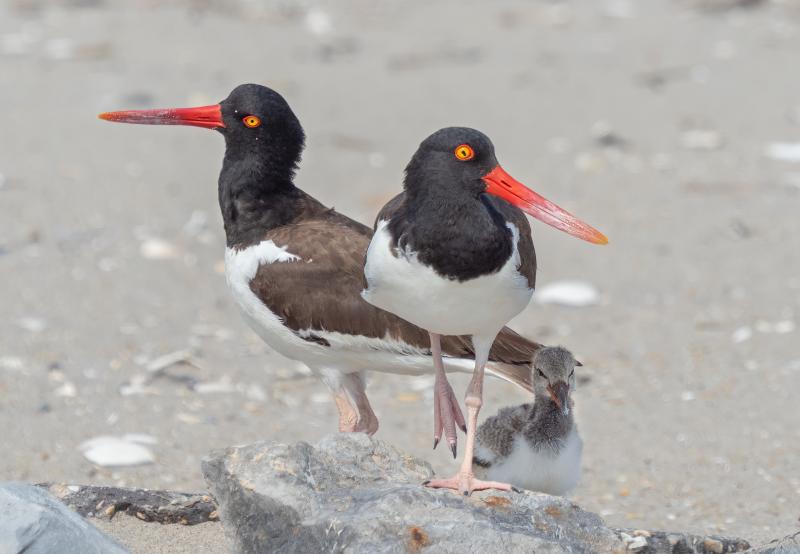 This American oystercatcher pair with chick bred in coastal New York State. The species nested in Maine for the first time in the late 1990s and now are rare to uncommon breeders along much of the Maine coast. Photo by Rhododendrites, courtesy of Wikimedia Commons.
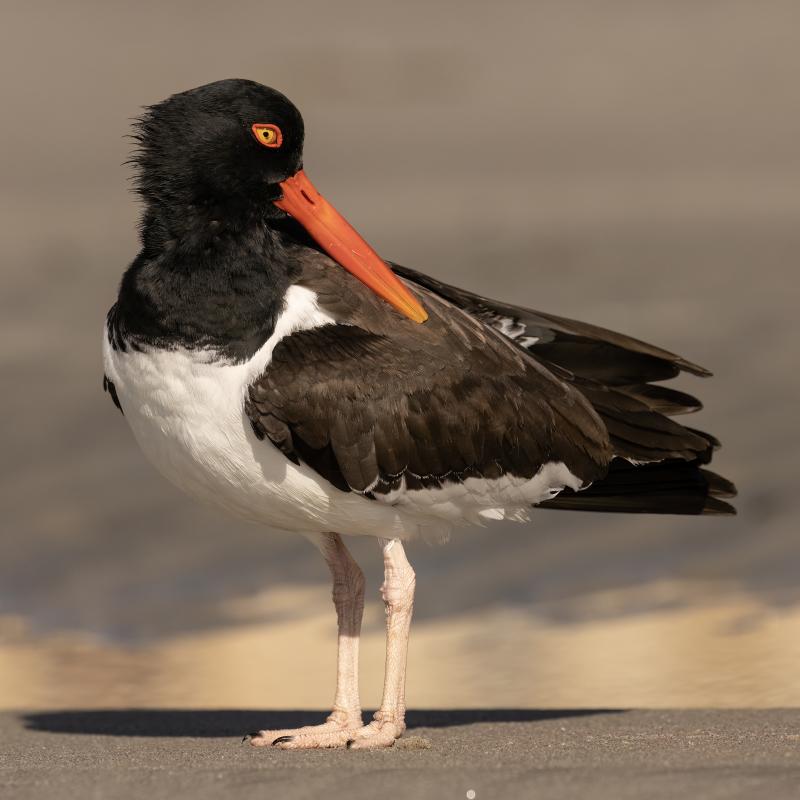 American oystercatchers use that thick orange bill to probe into the open shells of living oysters, mussels, and clams to quickly snip the muscle that holds the shells together, making the shellfish an easy meal. Photo by Chuck Homler d/b/a Focus On Wildlife, courtesy Wikimedia Commons.
This American oystercatcher pair with chick bred in coastal New York State. The species nested in Maine for the first time in the late 1990s and now are rare to uncommon breeders along much of the Maine coast. Photo by Rhododendrites, courtesy of Wikimedia Commons.
American oystercatchers use that thick orange bill to probe into the open shells of living oysters, mussels, and clams to quickly snip the muscle that holds the shells together, making the shellfish an easy meal. Photo by Chuck Homler d/b/a Focus On Wildlife, courtesy Wikimedia Commons.
American oystercatchers use that thick orange bill to probe into the open shells of living oysters, mussels, and clams to quickly snip the muscle that holds the shells together, making the shellfish an easy meal. Photo by Chuck Homler d/b/a Focus On Wildlife, courtesy Wikimedia Commons.
This American oystercatcher pair with chick bred in coastal New York State. The species nested in Maine for the first time in the late 1990s and now are rare to uncommon breeders along much of the Maine coast. Photo by Rhododendrites, courtesy of Wikimedia Commons.
American oystercatchers use that thick orange bill to probe into the open shells of living oysters, mussels, and clams to quickly snip the muscle that holds the shells together, making the shellfish an easy meal. Photo by Chuck Homler d/b/a Focus On Wildlife, courtesy Wikimedia Commons.Oystercatcher. It’s an evocative name. Even if you didn’t know that it refers to a bird, you would probably imagine some living thing that catches oysters. Even without considering its wonderful name, the American oystercatcher (there are 11 other oystercatcher species worldwide) is a memorable species. Its big, bright orange bill, black head, orange ring around the eye and bold white stripe visible against its otherwise dark brown wings and back—this all makes for a striking sight. Add in its loud, piping, whistled calls and you have a bird that is somewhere between a garish clown and an elegant fashionista.
For most of our years as birders, American oystercatchers were ultra rare in Maine. We saw our first ones in places like Florida and North Carolina. Later, we enjoyed seeing them on the sharp limestone terraces along the northern wave-tossed shores of Aruba, off the coast of Venezuela.
Over recent decades, American oystercatchers have expanded northward into Maine where they can be seen in small numbers across much of the coast. As their name implies, American oystercatchers eat oysters; they also feed on mussels, and clams as well as marine worms and, at least occasionally, other manageable sea creatures. They are adept at quickly finding and severing the muscle in bivalves that hold the shells together, thereby rendering the mollusks’ soft bodies easily accessible to be eaten.
While all this natural history is interesting, the name “oystercatcher” spurred us on to an interesting kind of word game that we played on the porch while watching the chimney swifts twittering overhead on a recent warm, summer evening. How many bird species could we think of in North America whose names describe how and what they eat?
All of the “flycatchers” came quickly to mind. It’s certainly pretty clear what they eat from the name, and though the manner of how they do their catching of flies is left a little to the imagination, still, there is a sense of the fact that they are active pursuers of flies and other insects they eat. We can list species like great-crested flycatcher, least flycatcher, alder flycatcher, and willow flycatcher as some of the birds in this name group.
Although unrelated to the “flycatchers” the “gnatcatcher”—as in blue-gray gnatcatcher—has a name that makes sense for describing its habit of fluttering about and grabbing and eating small insects (it is tiny bird itself).
Not a bird to be encountered in Maine is the “nutcracker.” Yes, the Clark’s nutcracker is a bird that harvests seeds from conifers, especially pine nuts. It’s found at higher elevation mountain habitats in the western U.S. The “seedeaters” are small birds often found in dry habitats, and they largely do in fact feed on small seeds. One species—the Morelet's seedeater—occurs just barely into the U.S. along the Rio Grande of south Texas.
Then there are the birds whose names describe what they eat but not how they procure their food. We came up with fish crow, worm-eating warbler, acorn woodpecker, snail kite, and grasshopper sparrow.
But no, the killdeer does not kill and eat deer. And you’ll be hard pressed to find a Sandwich tern munching down on anything between two slices of bread.
Jeffrey V. Wells, Ph.D., is a Fellow of the Cornell Lab of Ornithology and Vice President of Boreal Conservation for National Audubon. Dr. Wells is one of the nation's leading bird experts and conservation biologists. He is a coauthor of the seminal “Birds of Maine” book and author of the “Birder’s Conservation Handbook.” His grandfather, the late John Chase, was a columnist for the Boothbay Register for many years. Allison Childs Wells, formerly of the Cornell Lab of Ornithology, is a senior director at the Natural Resources Council of Maine, a nonprofit membership organization working statewide to protect the nature of Maine. Both are widely published natural history writers and are the authors of the popular books, “Maine’s Favorite Birds” (Down East Books) and “Birds of Aruba, Bonaire, and Curaçao: A Site and Field Guide,” (Cornell University Press).