Implementing a recycling program at Boothbay Region High School

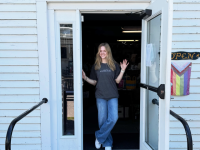
Have you ever heard of the Great Pacific Garbage Patch, otherwise known as “trash island?” “Trash island” refers to an island-like pile of trash that doubles Texas’s size that floats in the middle of the Pacific Ocean. It is a clear representation of how environmentally-conscious our world is–not very conscious at all. While one teenager can’t solve worldwide issues, she certainly can try to make some change in her community, which is what I, rising junior Natalie Flagg, aim to do by implementing a recycling program at Boothbay Region High School.
In an anonymous survey about a potential recycling program that I created for the student body receiving 120 responses, one student said: “There must be a reason we dont [sic] do it now.” One of those reasons why BRHS has never had a successful recycling program is because it just hasn’t been able to last.
Dr. Tricia Campbell, Boothbay Region High School principal, labeled this issue as the “The Start and Abandon Cycle,” meaning that one student starts a promising initiative, but after their graduation the program slowly peters out without any formal leadership on the project. I believe that partnering with the school’s environment club (known as ADEPTT, or Adolescents Driving Environmental Progress through Teaching and Technology) to keep the initiative going after I graduate will be the next step to success, as they can keep the program alive while pursuing other environmental interests.
Another argument that could be made is that we would have to find adequate funding from the school for the initiative and for transportation. At Dr. Campbell’s suggestion, I did some digging, and I found some grant opportunities that we could apply to such as through ecomaine (a program offering grants to support school sustainability), Natural Resources Council of Maine, or Maine Department of Environmental Protection. If we get the grant, we could then pay for a service such as Giles Rubbish to transport the materials so our students and staff wouldn’t have to deal with the transportation piece. There are many ways to make this possible; we just need to commit to making this dream a reality.
As of right now, our school has bins placed in classrooms used to collect cans that are used to help fund Project Graduation, and I am not suggesting that we take that initiative away from them; instead, I am focused on separating paper products from trash such as food wrappers or other containers. Every two months I clean out my school folders in my bag, which leads to me disposing of at least 100 sheets of paper with nowhere to put it except in the normal trash bin, and every time I do it, it breaks my heart a little. I have been advocating for a recycling program in both of the Boothbay schools for a long time, stemming from my piqued interest in climate change advocacy starting in a 3rd grade environment discussion in Girl Scouts. Though I was never successful in implementing a program during my elementary years, maybe I can now finally achieve my 8-year-old self’s goals.
Out of the 120 responses I received from the survey, 91.7% said that a recycling program would either “definitely” or “might” be beneficial. When asked to expand on that, one student said that the program, “could promote environmental awareness + help reduce waste,” which summarized many other responses; 66.7% of the students said that they had either learned very little (in or out of class) about how recycling affects the environment or had learned nothing at all, so environmental knowledge became another key piece of the initiative. Another student very passionately said, “WE’VE GOTTA SAVE THE EARTH,” which very clearly showed how much our student body cares about this issue.
Our environment is changing rapidly, and my generation has to adapt to these changes in order to ensure that Earth is habitable for our future grandkids, meaning that we have to accept the mindset that no change is too small. While implementing a recycling program in one public high school doesn’t mean that the Earth is magically saved, it does mean that awareness will be spread throughout our community, and will make the Boothbay region a cleaner place to reside.