Following the Clues from a 1717 Newspaper
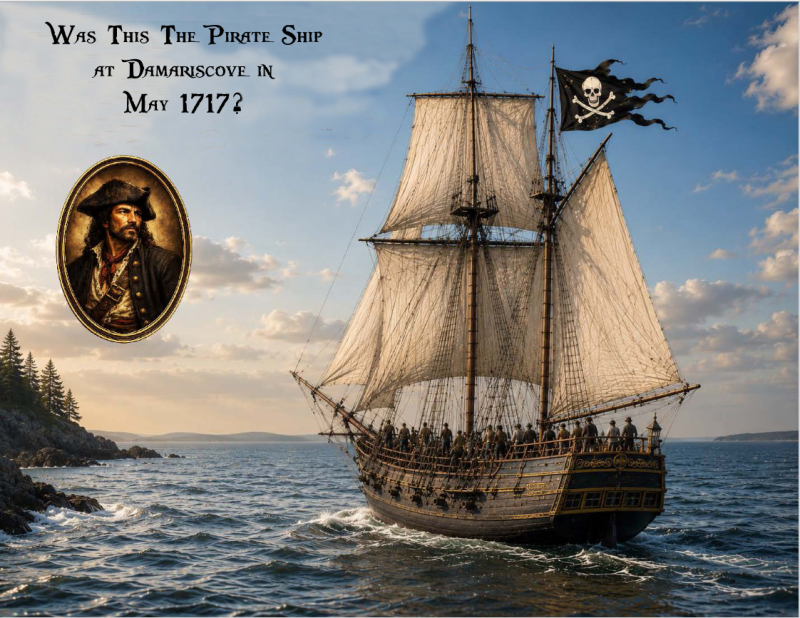
In the last article, we introduced an intriguing report from the Boston News-Letter of May 20–27, 1717. If you missed it, here is the content: “Piscataqua –May 24. Fishermen tell us, that the Pirate Sloop of 8 Guns left Richmonds Island last Lords Day, and others tell us, that both the Pirate Sloops are together at Damerill’s Cove Careening, and that one of them has about 90 Men on board her. We have heard nothing as yet of Col. Walton, whom His Excellency sent out from hence in quest of the Pirates.”
That primary source document states that pirates were plying the waters of the Maine coast,specifically the Cape Elizabeth and Boothbay Harbor regions. Readers of the Boothbay Register’s August 4, 2026 issue were invited to answer questions, so today I will share what we know.
Our answers lie not in legend or hearsay, but in historical records. As we begin to piece those clues together, an extraordinary story starts to emerge - one that leads from the Caribbean to the coast of Maine andjust might change the way we think about Boothbay Harbor's place in pirate history.
Clue #1 – Where Were Piscataqua and Richmond Island?
In colonial times, Piscataqua referred to the harborand river region surrounding present-dayPortsmouth, New Hampshire, and Kittery, Maine. Derived from a Native American word associated with the area’s branching river, Piscataqua had becomean important center for fishing, shipbuilding, and maritime trade.
Farther up the coast, Richmond Island, a 226-acre island just offshore from present-day Cape Elizabeth, offered mariners a convenient place to anchor, obtain fresh water and provisions, and find some protection from the open sea. Its separation from the mainland and proximity to coastal shipping routes also made it a convenient stopping place for vessels moving along the Maine coast.
Clue #2 – Where Was Damerill's Cove?
The place identified in the 1717 Boston News-Letter as "Damerill's Cove" is the island we know today as Damariscove, located about six miles south of Boothbay Harbor. Long before pirates appeared in these waters, the island provided European fishermenwith codfish, freshwater, and a sheltered harbor.
By the early 1600s, Damariscove had become an important fishing and trading outpost, appearing in early records under several spellings. According to local history, Sir Humphrey Damerill established a trading post there in 1608; thus, his name is associated with the evolution of today's Damariscove.
So why would pirates have been attracted to this remote island in May 1717? Its topographical features of a narrow harbor with steep, high shorelines offered protection from weather and seclusion from the watchful eyes of authorities. Also, years of warfare and conflict resulted in the abandonment of the fishing station and a complete evacuation of settlements on the mainland, leaving the island far more isolated than prior years.
Clue #3 – What Does It Mean to Careen a Ship?
Once or twice a year, pirates intentionally beached the vessel at high water. As the tide receded, the exposed hull could be scraped clean of marine growth, inspected, and repaired. Heavy cannons, cargo, and water barrels were unloaded to lighten the ship before running it aground.
The sheltered location of Damariscove served the pirates well during the careening process because without cannons in place they were extremely vulnerable during this time. Thus, speed and secrecy were of utmost importance because with the ship on its side, and cannons on the shore, they were defenseless.
Clue #4 – Who Were Colonel Walton and “His Excellency”?
Colonel Shadrach Walton (1658–1741) was a prominent colonial military commander, judge, and public official from New Hampshire. He commanded Fort William and Mary protecting the New Hampshire coastline and led provincial troops during regional conflicts in the early 18th century.
In the May 24tharticle it stated, “We have heard nothing yet of Col. Walton, whom His Excellency sent out from hence in quest of the Pirates.”In a May 31st posting it stated, “Colonel Walton is returned from his Cruise in quest of the Pirates, not having seen or met with any.” Thus, it appears that the piratesreported at Damariscovemust havedeparted prior to his arrival.
“His Excellency” was Samuel Shute, an English military officer and royal governor of the provinces of Massachusetts and New Hampshire. One of Governor Shute’s responsibilities was to confront the growing piracy threat along New England's coast. His decision to send Colonel Walton after theDamariscove pirates suggests that authorities took the reportseriously.
Clue #5 – Who Were These Pirates?
If you were asked to name a pirate who roamed the Coast of Maine, who would it be? Most people might say Dixie Bull or Captain Kidd; however, the latter has no factual basis to back his presence, and both predated the pirates reported at Damariscove in 1717.
In our next article, we'll follow the surviving clues of ships, dates, locations, crew sizes, and eyewitness reports to three suspects: Samuel ‘Black Sam’ Bellamy, Paulsgrave Williams and Richard Noland. Were these the pirates careening at Damariscove in May 1717? The evidence may bring us surprisingly close to an answer.
Until then, sign up for the Boothbay Harbor Treasure Hunt – a fun, multigenerational adventure that allows pirates (young and old alike) to explore the region, visit local businesses, and learn about local maritime history – all while supporting “Education Boothbay,” a local place-based learning initiative.