Who were the real pirates plying Boothbay Harbor's waters?
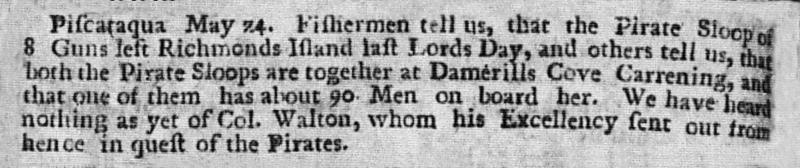 A clipping from the Boston News-Letter, America's first continously published newspaper, in 1717. Courtesy photo
A clipping from the Boston News-Letter, America's first continously published newspaper, in 1717. Courtesy photo
A clipping from the Boston News-Letter, America's first continously published newspaper, in 1717. Courtesy photo
When most people think of pirates, they picture the turquoise waters of the Caribbean, not the rocky shores and islands of mid-coast Maine. Yet hidden among early records is evidence that real pirates once sailed the waters off Boothbay Harbor.
During the Golden Age of Piracy (1650–1730), merchant ships returning to Europe from the Caribbean traveled north along the U.S. eastern seaboard before catching the Gulf Stream and favorable winds to carry them eastward across the Atlantic Ocean. Laden with sugar, rum, tobacco, and other valuable cargoes, these vessels became irresistible targets for pirates seeking riches.
But what does this have to do with Boothbay Harbor? Surprisingly, quite a lot!The region’sdeeply indented coastline, dotted with remote islands and secluded coves, offered excellent places to hide, repair ships, gather supplies, and avoid authorities.Maine’s summer climate also offered a favorable escape from extreme tropical heat and hurricane risks.
While creating the Boothbay Harbor Treasure Hunt, one of our primary goals was to introduce participants to the authentic maritime history hidden throughout our harbor by reading colonial newspapers and historical records. Along the Treasure Hunt route, participants discover some of these fascinating pieces of Maine's seafaring past. This articlebegins a series that will expose readers to remarkable accounts of pirates in the Boothbay region.
Research for the Treasure Hunt led us to the Massachusetts Historical Society, where we struck “pirates’ gold.”Primary source documents such asnewspapers, official correspondence, and firsthand accountsuncoveredreal pirate activity along the Maine coast. Two reference librarians kindly assisted with the search, one of whom was Hannah Elder,a Boothbay Region High School graduate from the Class of 2013.
One of the most intriguing discoveries appears attached. The following excerpt comes from the Boston News-Letter, America's first continuously published newspaper. As you read the clipping from its May 20–27, 1717 edition, remember that early English printers used a "long s," a letter that resembles our modern-day "f."
This short newspaper account raises several fascinating questions about the mysterious vessels hanging out in 1717.
Where were Piscataqua and Richmond Island?
What local island was once known as Damerill's Cove?
What does it mean to "careen" (correct spelling) a ship?
Who was Colonel Walton, and who was the "His Excellency" that sent him in pursuit of pirates?
Most importantly...who might these pirates have been?
Those questions are exactly what make history so exciting.We invite you to do a little detective work of your own before the next article appears. You may be surprised by what you discover.
In our next installment, we'll introduce pirates who ventured into the waters of Boothbay Harbor, Maine. The story is one of the greatest pirate stories ever recorded – one you won't want to miss.
In the meantime, why not experience a bit of that history yourself? Join the Boothbay Harbor Treasure Hunt, where clues, adventure, and authentic local history combine to create an unforgettable family experience. Register online at www.lighthouseeducation.org/treasure.
Proceeds from the Treasure Hunt, sponsored by the nonprofit Lighthouse Education & Nautical Studies (LENS), support“Education Boothbay,” a place-based learning initiative that provides experiential learning for local schoolchildren with the rich natural and maritime heritage of their communities.