Southport residents attend hearing on Hendricks Hill Beach project
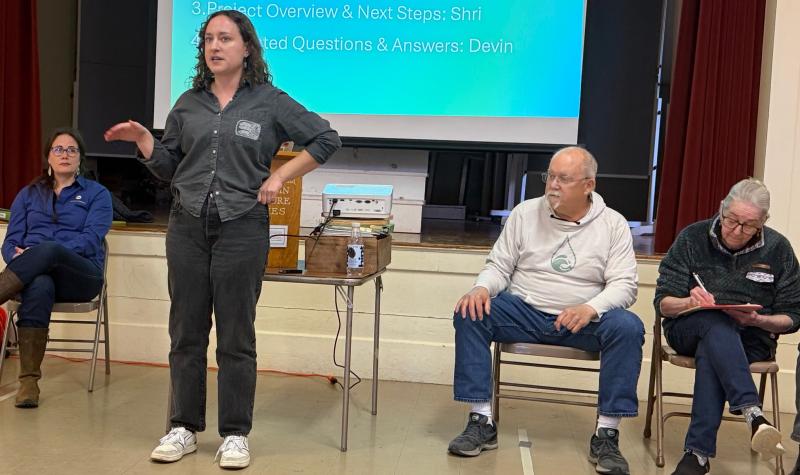 Devin Domeyer is community liaison for the Hendricks Head Beach Restoration Project in Southport. April 15, she led a public discussion at Southport Town Hall. BILL PEARSON/Boothbay Register
Devin Domeyer is community liaison for the Hendricks Head Beach Restoration Project in Southport. April 15, she led a public discussion at Southport Town Hall. BILL PEARSON/Boothbay Register
Devin Domeyer is community liaison for the Hendricks Head Beach Restoration Project in Southport. April 15, she led a public discussion at Southport Town Hall. BILL PEARSON/Boothbay Register About 40 residents received an update on the Hendricks Head Beach Restoration and Resilience Project April 15 at Southport Town Hall. The federal project has an estimated $1,803,785 cost. The project is a pre-hazard mitigation and coastal resilience project intended to protect Hendricks Head Beach. The project's purpose is shoring up the adjacent seawall, and elevating Beach Road and the surrounding parking area.
Shri Verrill is the consultant hired by the town. The town used a state Community Resilience Partnership Grant, established by Gov. Mills in 2021, to hire Verrill. Verrill later assisted Southport in seeking a larger federal grant to cope with the impact of climate change.
During the public hearing, Verrill told residents the December 2023 and January 2024 storms caused significant damage, including about $60,000 in repairs to the road and parking areas near the seawall, and temporarily interrupted emergency vehicle access to the beach and nearby homes.
As part of a state grant, she applied for federal grants in order for the restoration project to proceed. Beach Road is being elevated to reduce flooding risk from sea level rise, high tides and storm surge. The design is based on projected sea level rise through the year 2100, with an estimated 3.9 feet of rise over current conditions.
Under the selected design, the road is expected to remain above projected year-2100 astronomical high tides under calm conditions and above today’s most severe observed tide-plus-surge events. Major storm surges later this century could still overtop the roadway, said Verrill.
The proposed project is expected to secure Southport's shoreline for about 80 years, according to the data research. Verrill further explained how the proposed design would protect Hendricks Head Beach. The proposed design would improve resilience while minimizing impacts to adjacent wetlands and neighboring properties.
Nearly all the project funding is expected to come from federal grants. The estimated $1,803,785 was originally submitted under the Fiscal Year 26 Congressional Directed Spending Cycle, according to Verrill. The town later received notice of a proposed $1,165,000 from the U.S. Senate which advanced through its Appropriations Committee, but the U.S. House of Representatives hasn't approved the expenditure.
Due to anticipated increases in construction materials and labor, the updated estimate is now $1,945,265. The final cost will not be known until engineering, permitting, bidding, and contractor pricing are complete, according to Verrill.
At the request of U.S. Sen. Collins’ staff, the town resubmitted the project for the FY 27 Congress Directed Cycle.
The plan is to raise the roadway by about 365 linear feet. The proposed centerline elevation is 11 feet NAVD88. NAVD88 is the North American Vertical Datum of 1988. It is a vertical control datum established in 1991 to provide a consistent reference for measuring orthometric heights (elevations) across North America.
The culvert is being replaced. The strom drain is undersized and can cause water to back up upstream during storm events. The new culvert is a 12-foot-wide by 6-foot-high by 60-foot-long precast concrete four-sided box culvert. About half of the culvert will be buried to allow for natural sheet flow and improved ecological function, said Verrill.
The culvert is intended to restore tidal exchange between ocean and the approximately 8.9-acre inland wetland, improve water movement and sediment transport, reduce upstream flooding caused by an existing undersized pipe, and improve long-term drainage and coastal function.
The current seawall is about 225 feet long and constructed of concrete and stone. The plan is to replace the seawall with a stacked boulder seawall with a top elevation of 11.5 feet NAVD88.
The project also includes about 340 square feet of living seawall habitat panels designed to support marine habitat and improve ecological value along the shoreline. Verrill said the new wall will better withstand storm and wave forces, support increased roadway elevation, improve long-term resilience and incorporate nature-based coastal design features.
"Engineering analysis concluded that the selected alternative provides protection through current extreme tide and surge conditions, Verrill said. "While larger storm surges later this century may still overtop the road, the selected option was determined to provide the best balance of resilience, cost, environmental protection, and impacts to neighboring properties."
During the question-and-answer period, one resident asked how much Southport taxpayers would spend on the project. Verrill responded about $20,000. "Seventy-five percent comes from the federal grant. Southport is seeking grants for the other 25%. So, you may end up spending about $20,000 as part of a match."