The Robin That Mistook A Dandelion Stem For a Worm
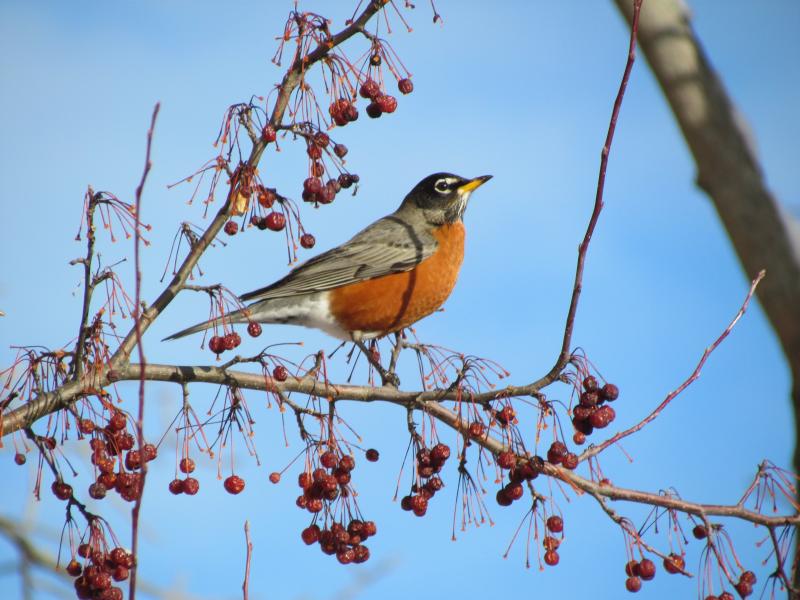 American robins are very adaptable when it comes to finding a meal. In winter, they'll eat berries and other dried fruits. Courtesy of Jeff Wells
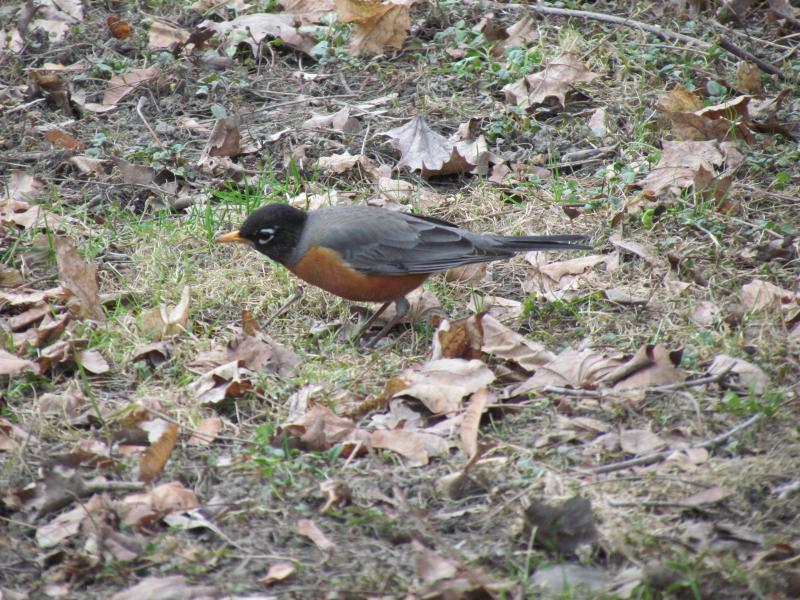 Many of us have seen robins listening and watching for earthworms in the yard, like this one is doing. This food source has become widely available since nonnative earthworms were brought in to northern North America since European colonizers arrived on the continent. Courtesy of Jeff Wells
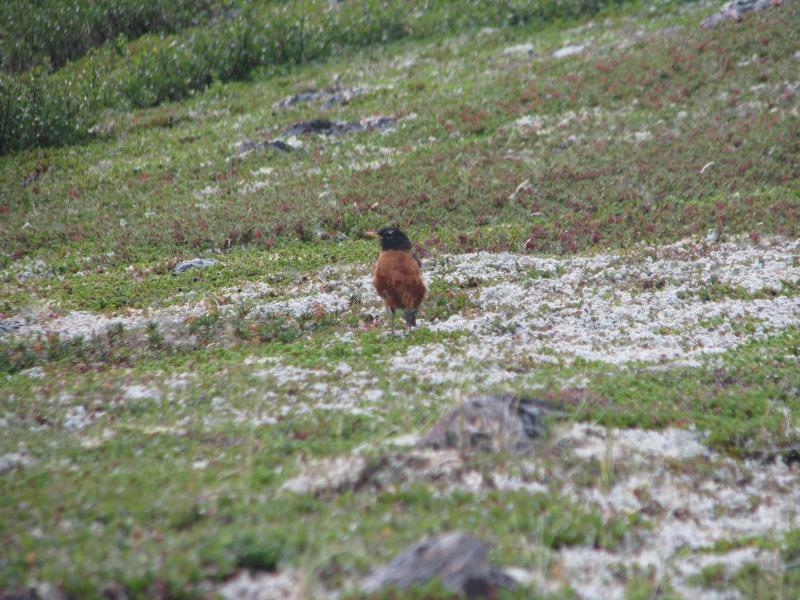 The adaptability of American robins has allowed them to range over much of the North American continent. This one was thriving in the treeless expanse of the Ungava Peninsula of northern Quebec. Courtesy of Jeff Wells
American robins are very adaptable when it comes to finding a meal. In winter, they'll eat berries and other dried fruits. Courtesy of Jeff Wells
Many of us have seen robins listening and watching for earthworms in the yard, like this one is doing. This food source has become widely available since nonnative earthworms were brought in to northern North America since European colonizers arrived on the continent. Courtesy of Jeff Wells
The adaptability of American robins has allowed them to range over much of the North American continent. This one was thriving in the treeless expanse of the Ungava Peninsula of northern Quebec. Courtesy of Jeff Wells
The adaptability of American robins has allowed them to range over much of the North American continent. This one was thriving in the treeless expanse of the Ungava Peninsula of northern Quebec. Courtesy of Jeff Wells
American robins are very adaptable when it comes to finding a meal. In winter, they'll eat berries and other dried fruits. Courtesy of Jeff Wells
Many of us have seen robins listening and watching for earthworms in the yard, like this one is doing. This food source has become widely available since nonnative earthworms were brought in to northern North America since European colonizers arrived on the continent. Courtesy of Jeff Wells
The adaptability of American robins has allowed them to range over much of the North American continent. This one was thriving in the treeless expanse of the Ungava Peninsula of northern Quebec. Courtesy of Jeff WellsWe wish we had been able to get a photograph of it to show you.
The first crop of baby American robins were out of the nest in our neighborhood by the last week of May. We have enjoyed hearing their squeals and seeing the gangly youngsters, with their short tails and brown spotted breasts, looking a little like a punked-out version of the adults.
One morning, we heard the familiar begging squawks outside our kitchen window. There on the edge of the lawn was one of these young robins nestled beside a large dandelion, its yellow blossoms long gone. The baby robin pecked at the white button on the top of the dandelion stem where a few of the familiar fluffy white parachutes on the seed head remained.
Ten minutes later, we stepped into the backyard to fill the bird feeder and were surprised to see that same young robin still huddled up next to the dandelion. Imagine our shock when we realized that the bird had swallowed much of the dandelion stem. It was like a fish on a hook, frantically trying to pull itself away from us to make its escape.
Finally, the stem slid back out of the bird’s throat, and the little robin darted into the shade of the nearby bushes. We were glad to spy it again later, begging for food from its parents with its high-pitched cries and looking none-the-worse for wear.
Our interpretation of this event was that this young robin, at the height of its hunger, must have had mistaken the long, thin, pinkish dandelion stem for one of the long, thin, pink earthworms it had been receiving as food from its parents. It had, in short, encountered a novel object in its environment and had tried to make sense of it despite its limited experience in life (perhaps only a couple of weeks in the nest and few days out of it).
Maybe the adaptability of robins to consider novel objects as potential food—or at least to explore them further—is a reason why they have been successful in adapting to so many different landscapes.
American robins nest from the Arctic (northern Alaska, northern Northwest Territories, and the western parts of Nunavut) across the Boreal Forest biome and south through almost everywhere in the U.S. and in the high elevation forests of Mexico. They can be found in suburbia, city parks, and in remote, pristine wilderness settings.
At one point, before European and Asian earthworms were accidentally introduced and quickly spread across North America, an American robin couldn’t have pulled a worm out of the ground to feed its young over the northern half of its range. That’s because glaciers had occurred there and wiped out any native earthworm species. They couldn’t survive under the ice sheet. However, native earthworms were on the menu south of the northern tier of U.S. states.
We are trying to imagine the first robin that came across an earthworm near one of the early European settlements, perhaps even near modern day Pemaquid Harbor or Popham. Did a robin see a worm that had been brought over in some ballast piled on the shore and peck at this novel long, pink, squirming thing—and swallow it? Unlike the robin with the dandelion stem in our backyard, the first robin to sample one of the newly transplanted European earthworms must have realized this new food was pretty good. Did other robins learn from that one or did many robins react to this novel food independently as earthworms spread in the years after Europeans began colonizing and spreading themselves?
Many humans are likewise adaptable when it comes to trying novel food prospects. Some people have begun harvesting and eating the invasive European green crabs that have made their way to the shores of Maine. In some tropical regions of the world, lionfish have been introduced to reefs, and humans are harvesting them and eating them as a way to lower their populations and enjoy a seafood meal—they are, apparently, quite tasty.
Jeffrey V. Wells, Ph.D., is a Fellow of the Cornell Lab of Ornithology and Vice President of Boreal Conservation for National Audubon. Dr. Wells is one of the nation's leading bird experts and conservation biologists. He is a coauthor of the seminal “Birds of Maine” book and author of the “Birder’s Conservation Handbook.” His grandfather, the late John Chase, was a columnist for the Boothbay Register for many years. Allison Childs Wells, formerly of the Cornell Lab of Ornithology, is a senior director at the Natural Resources Council of Maine, a nonprofit membership organization working statewide to protect the nature of Maine. Both are widely published natural history writers and are the authors of the popular books, “Maine’s Favorite Birds” (Down East Books) and “Birds of Aruba, Bonaire, and Curaçao: A Site and Field Guide,” (Cornell University Press).