New data shows Maine has yet to spend nearly two-thirds of its opioid settlement funds four years after payments began
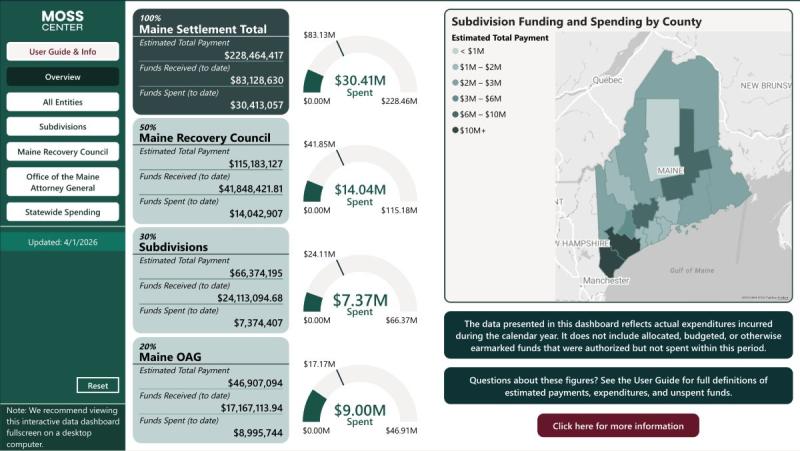 Screenshot of a new dashboard tracking opioid settlement spending from the Maine Opioid Settlement Support Center at the University of Southern Maine.
Screenshot of a new dashboard tracking opioid settlement spending from the Maine Opioid Settlement Support Center at the University of Southern Maine.
Screenshot of a new dashboard tracking opioid settlement spending from the Maine Opioid Settlement Support Center at the University of Southern Maine.Maine has spent just over a third of the opioid settlement funds it has received during the past four years, according to new data released this week by the Maine Opioid Settlement Support Center at the University of Southern Maine.
A data dashboard published Wednesday offers the first comprehensive picture of statewide spending since payments from nationwide settlements with companies accused of fueling the opioid epidemic began four years ago.
It adds to a report the MOSS Center released last month on spending by local governments by showing that data alongside spending by the Maine Recovery Council, which is receiving half of the state’s share, and the attorney general’s office, which is getting a fifth of the funds.
The state has so far received $83 million, a total that is expected to grow to $230 million by the time payments wrap up in 2038. Additional settlements with Purdue Pharma, the Oxycontin manufacturer, and eight other pharmaceutical companies reached last year could add up to $30.3 million more to Maine’s total.
The money from the settlements is intended to address the harms of the opioid epidemic through prevention, harm reduction, treatment and recovery initiatives.
But it’s taken years for many recipients to get money out the door, if at all, with money incoming far outpacing money outgoing: Total spending across the Maine Recovery Council, local governments and the attorney general’s office comes to $30.4 million, or 37 percent of the $83 million in their accounts so far.
Two-thirds of that, $19.2 million, was spent last year, according to the MOSS Center. The 15-member Recovery Council is responsible for the majority of the spending, investing $14 million in dozens of projects statewide.
A law passed last year made it so that the 39 counties and municipalities, or direct share subdivisions, receiving opioid settlement funds must report their annual spending to the AG’s office each January. The AG’s office must then submit those reports to the Legislature’s committee on health and human services.
The MOSS Center, which was established in 2024 using $2.5 million of the AG’s office’s opioid funds, compiled, analyzed and presented the subdivisions’ reports, and combined those with spending data from the AG’s office and the Recovery Council to create the public dashboard. This also satisfied a requirement in the state’s memorandum of understanding with the subdivisions that the Recovery Council’s data be made public.
The dashboard clearly shows how much remains unspent in each subdivision. Bangor, for instance, has only spent $37,000 of $1.25 million — to pay for syringe cleanup and fund two intensive case manager positions — while Portland has only spent $44,000 of $1.7 million so far, all on its syringe service program. Some of the local governments have yet to spend any money at all. Auburn, for instance, is sitting on $660,000.
In neighboring Lewiston, meanwhile, nearly half of the city’s $1.05 million has been spent to hire crisis workers to assist police, expand recovery housing, install sharps containers, host substance use prevention workshops for at-risk youth, and more.
The data shows that half of all spending last year went to community-based organizations for projects and programming ranging from residential treatment to youth prevention. For example, the Recovery Council spent more than a million dollars to support syringe service programs operating in nine counties across the state.
One of those programs is the Opiate-Free Island Partnership, which serves Deer Isle and Stonington in Hancock County. In this “rural island community with extremely limited access to off-island supports,” the project description states, the partnership aims to “close critical service gaps” by providing harm reduction supplies like naloxone, the overdose reversal medication, increasing school-based youth prevention programming and helping people find treatment.
The description notes that the partnership “anchors these services locally by training and staffing community members, building trust in a small rural setting where stigma is a major barrier to care.”
Although the Recovery Council approved its first $9 million in funding in December 2023, it took months for money to get distributed as contracts were finalized. The council approved another $13.9 million in grants in November 2024. But only $14 million has been distributed so far — all in 2025.
That included $1.1 million each to Milestone Recovery in Portland and Tessa’s House in Washington to expand their residential treatment and medical detoxification programs. The council also supported two housing programs for women with children: Northern Light’s McAuley Residence, which provides residential treatment for pregnant women and women with children at locations in Portland and Bangor, and Healthy Acadia’s Safe Harbor, a recovery home in Machias. In total the council has funded 59 projects.
The AG’s office gave $1 million to Mainspring, a pilot program led by Fair Tide and Footprints Food Pantry in collaboration with several area agencies in York County. The funding from the AG’s office will support its case management services, food security program, outreach efforts and resource navigation for people in recovery. The AG’s office has spent $9 million of the $17.2 million it has received to date.
In total, just under half of all projects funded last year were for harm reduction and recovery initiatives. Treatment programs received slightly less funding and prevention efforts received the least. Many projects met more than one of the four pillars.
The data in the dashboard reflects money that had been spent as of the end of 2025; it does not show how funds may have been allocated or budgeted for future projects. In addition to spending amounts and project descriptions, it also shows how much has gone to each county and offers details on the decision-making process each of the different entities is using to make spending choices. Many of the local governments have yet to institute formal spending policies.
This story was originally published by The Maine Monitor, a nonprofit civic news organization. To get regular coverage from The Monitor, sign up for a free Monitor newsletter here.

Sponsored Content
Main Street Shop






Sponsored Content
Main Street Buzz