'Who is freedom for?': Slavery in colonial Maine
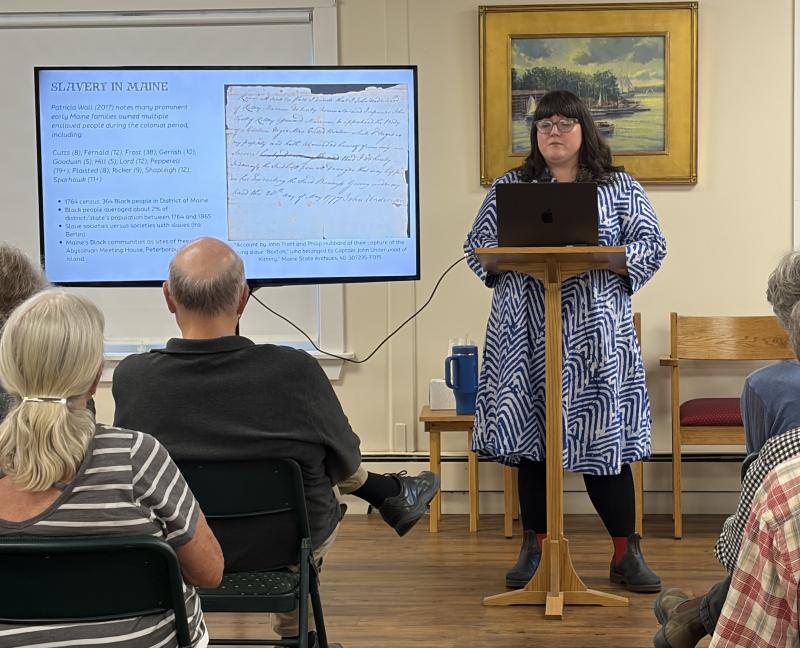 Dr. Kate McMahon. ISABELLE CURTIS/Boothbay Register
Dr. Kate McMahon. ISABELLE CURTIS/Boothbay Register
Dr. Kate McMahon. ISABELLE CURTIS/Boothbay RegisterWho is freedom for? That was the question Dr. Kate McMahon posed Aug. 18 during her lecture exploring the impacts of the American Revolution on enslavement in Maine, and the efforts of resistance and abolition by Black Mainers and allies.
Sponsored by a grant from Maine State Library, this was the third talk in Boothbay Harbor Memorial Library’s Revolution-themed series. McMahon is executive director of Castine Historical Society, co-founder and board member of Atlantic Black Box and serves on the Operational Committee for slavevoyages.org
“We are in a moment of remembering the American Revolution and all the promises that the Declaration and other documents that founded this country made to us. Yet we often overlook and misunderstand the relationship between Maine, this country and the legacies of racism and slavery,” said McMahon.
During the Revolutionary period, slavery in New England was a small, slow-growing institution reserved for the wealthy, mainly due to Wabanaki resistance keeping colonial settlements regulated to the coasts. By the mid-1700s, there were 154 enslaved men and women in Maine and about 3,500 in Massachusetts Bay Colony, which included Maine. By comparison, New York had over 15,000.
“However, that does not mean that slavery was non-existent or that it was milder than the South.”
There are accounts of people being beaten to death by their enslavers, records of slave markets in Maine as early as the 1650s, and many Mainers made their fortunes in the global slave economy, McMahon said.
One example of the latter is Sir William Pepperell, a wealthy merchant and son-in-law of a slave trader, who lived in Kittery Point. In 1719, he paid for five captive Africans to be brought from Antigu; he later received a letter expressing sympathy for the loss when one of the captured women died during the crossing.
“Of course, the loss that (the writer) is talking about here is not the loss of human life. It is the financial loss of (Pepperell’s) significant investment in trafficking these people from Antigua to Maine.”
Therein lies the contradiction: American colonists were declaring their freedom from the tyrannies of Great Britian while also capturing and holding others in bondage. The inconsistency is present in the Declaration.
In the final grievance, the document accuses the king of exciting “domestic insurrections among us;” a reference to the 1774 Lord Dunmore Proclamation that allowed those enslaved by patriot owners to gain freedom if they fought on the British side. Fear of uprisings, especially in places the black population greatly outnumbered the white one, was a persistent concern well into the 19th century, said McMahon.
In the end, 20,000 African Americans served under the British and, after the patriots decided to offer the same emancipation deal to those enslaved by loyalists, 9,000 for the Continental Army. This included the Massachusetts-based, all-black militia, “Bucks of America.” Other than the name and a ceremonial flag presented at war’s end, there is little known about them.
Beyond military service, another road to emancipation was to file "freedom suits,” a small number of which went to court right before and after the Revolution. The most influential was Elizabeth Freeman’s, a.k.a. Mum Bett, whose case overturned the legality of slavery in Massachusetts and led to total abolition in 1783. The ruling extended to Maine. However, the provision that citizens were barred from participating in the slave trade was not often followed.
Black communities in the state began to take shape after the Revolution; these were beacons for those escaping enslavement or simply moving. McMahon highlighted one such community outside Warren, Peterborough, started by Sarah and Amos Peters. The community was on a 150-acre plot Amos got under “general agreement” from Founding Father Henry Knox. How they came to know each other is unclear.
Areas like these were safe havens from legal boundaries as laws beginning in the 1600s limited black people’s behavior, relationships, citizenry and movement. McMahon also pointed out that one of Maine’s first laws upon becoming a state in 1820 was anti-miscegenation.
“We like to think that we do not have codified racism here like they did in the South. We don't have Jim Crow, and yet one of our first founding laws bars interracial marriage for 100 years.”
The idea of the small, supposedly benign nature of slavery in colonial New England is countered by the number of people who fled their enslavers, and how they had to move about in the world afterwards as other laws endeavored to restrict them. So, when we remember the Declaration’s promise of freedom, it's important to acknowledge those left out of the conversation, said McMahon.
The final talk is Tribal Ambassador for the Houlton Band of Maliseets Osihkiyol Crofton-Macdonald's “The Watertown Treaty of 1776: A Wabanaki Perspective” on Sept. 2 at 6 p.m. at Harbor Theater.