Boothbay Harbor looks 12 years ahead with new comp plan
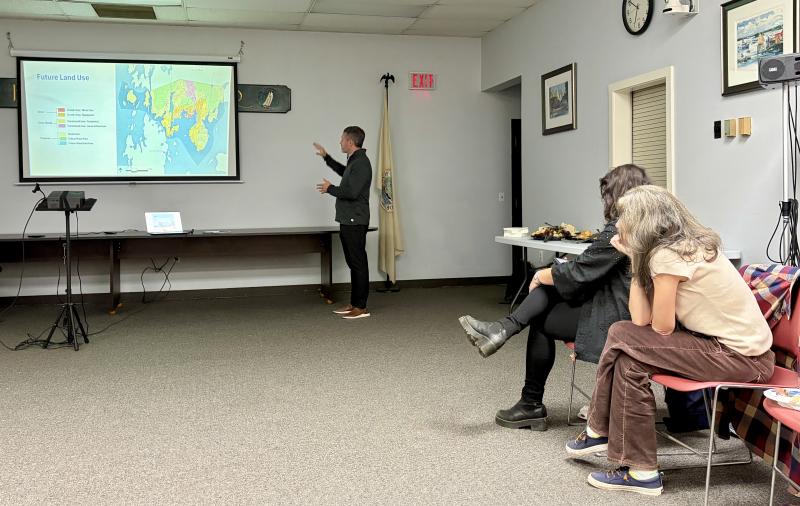 VHB Project Manager Luke Mitchell maps out areas of development in a draft Future Land Use Plan (FLUP). Maine is one of the only states that require a FLUP as part of a comprehensive plan. ISABELLE CURTIS/Boothbay Register
VHB Project Manager Luke Mitchell maps out areas of development in a draft Future Land Use Plan (FLUP). Maine is one of the only states that require a FLUP as part of a comprehensive plan. ISABELLE CURTIS/Boothbay Register
VHB Project Manager Luke Mitchell maps out areas of development in a draft Future Land Use Plan (FLUP). Maine is one of the only states that require a FLUP as part of a comprehensive plan. ISABELLE CURTIS/Boothbay Register
Oct. 7, Boothbay Harbor held its third and final public workshop for feedback on its comprehensive plan draft, which will help chart the next 12 years of town development. This year-long planning process was undertaken in partnership with VHB, Inc., who gathered input from public meetings, surveys and sessions with an advisory committee of elected town officials, business owners and residents.
A comp plan is a vision document that records a community’s origins, its present state and desired direction. Per Maine state guidelines, the plan must include a Future Land Use Plan (FLUP) that shows how development will change land use. An implementation plan outlining methodology and responsible entities is also required. This helps translate community visions into action, eases coordination with regional and state policies, and prioritizes limited financial and staff resources.
After the plan is finalized, it will be sent to the state for approval. The goal is for residents to vote for adoption at the May town meeting.
Hosted by VHB Project Manager Luke Mitchell, the presentation covered land use, housing, economic development, historic and cultural resources, town facilities and services, transportation and mobility, recreation, agricultural and forest resources, natural and water resources, marine resources, and fiscal capacity, with an assessment of current conditions and future goals for each.
For land use, expanding planning/economic development staffing, modernizing zoning ordinances and permitting, aligning regulations with FLUP and mapping priority redevelopment and infill opportunities were identified as goals.
Hiring, or contracting, a town planner was named a high priority to ensure implementation across categories as the town's prior comp plan, in 2015, failed on that front. Attendees also emphasized flexibility to make room for unseen developments.
‘We’ve had numerous situations where we have tried to correct something over the last (few) years, and we're told we can’t do that because what we're trying to suggest isn’t in the last comprehensive plan,” said Selectman Ken Rayle.
Mitchell presented the draft FLUP, identifying areas to grow, grow slowly, or preserve. Most fast-growth sectors were in the downtown and surrounding areas. Mitchell clarified that growth did not necessarily mean adding new levels of density but rather redeveloping underperforming or underused properties. Allowing more uses per square foot or increasing downtown building height limits for second-floor shops or apartments was discussed.
Housing focused on the lack of affordable housing and the prominence of seasonal rentals. Goals are creating a housing action plan, a short-term rental registration program to map these properties for future policies, supporting accessory dwelling units and diverse housing types, and expanding workforce housing through zoning incentives. For economic development: Create a village center vision plan, advance four-season economic strategies, strengthen regional economic development partnerships, and improve wayfinding/visitor information systems.
On town facilities and services, recommendations were modernizing municipal/educational facilities and creating metrics for their performance, establishing maintenance and replacement schedules for equipment, and promoting regional service sharing. There were questions on how to coordinate with local quasi-municipal utilities, such as sewer and water, to support expansion.
Evaluating parking needs, strengthening regional transportation coordination and expanding sidewalks, trails and bicycles were floated under transportation. Other highlights include strengthening protections and expanding education for natural, marine (working waterfront) and cultural/historical resources, especially in relation to the changing climate.
However, the most important element of the plan is fiscal capacity, Mitchell said.
“More and more, as I've been doing comprehensive plans throughout New England, fiscal issues have become ... borderline crisis mode in the way that people speak about them.”
While Mitchell said Boothbay Harbor is currently financially stable, it's imperative to coordinate shared, regional cpaital investments, use tools to ease the budgeting and capital planning process and keep an eye on Augusta so grants can be readily anticipated and applied for.
The town aims to have the comp plan available on its website and social media pages in the coming days. In the meantime, those who want a copy can reach out to the town office.