BRAS marks 50 years
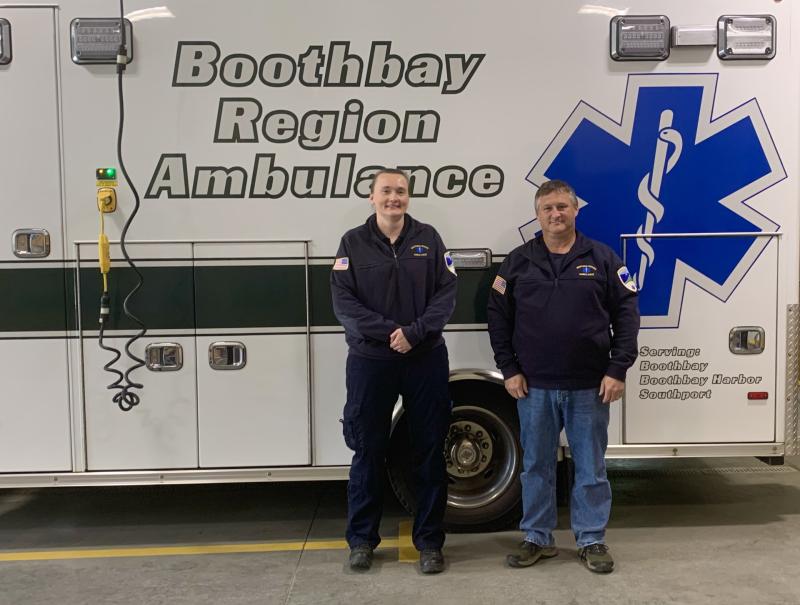 EMS Chief Kristen Roberts and BRAS Board President Robbie Ham look to the future as Boothbay Region Ambulance Service celebrates 50 years of service. ISABELLE CURTIS/Boothbay Register
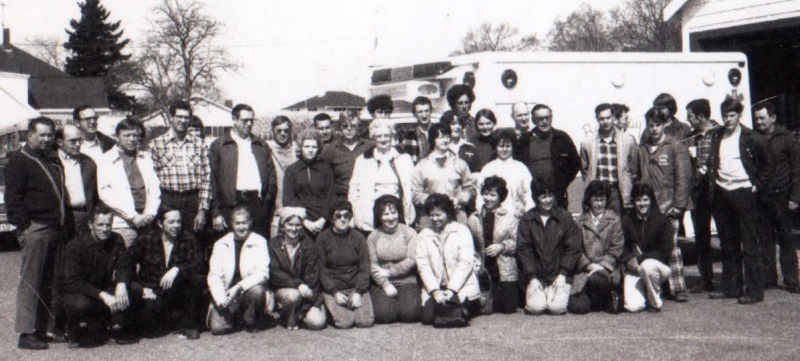 The inaugural Boothbay Region Ambulance Service crew. File photo
EMS Chief Kristen Roberts and BRAS Board President Robbie Ham look to the future as Boothbay Region Ambulance Service celebrates 50 years of service. ISABELLE CURTIS/Boothbay Register
The inaugural Boothbay Region Ambulance Service crew. File photo
The inaugural Boothbay Region Ambulance Service crew. File photo
EMS Chief Kristen Roberts and BRAS Board President Robbie Ham look to the future as Boothbay Region Ambulance Service celebrates 50 years of service. ISABELLE CURTIS/Boothbay Register
The inaugural Boothbay Region Ambulance Service crew. File photoBeing driven to the hospital for emergency medical services (EMS) used to be a morbid affair. Until the mid-20th century, funeral homes took over the duty of transporting patients since hearses, unlike most vehicles, were large enough to accommodate a stretcher.
The Boothbay region was no exception until 1976, when volunteers started Boothbay Region Ambulance Service (BRAS). Fifty years later, the not-for-profit organization now boasts eight full-time and 24 part-time employees, an EMS chief, and a fleet of four ambulances to provide round-the-clock care. BRAS is hosting a celebratory open house Aug. 7, from 3 to 6 p.m.
"It's amazing that the organization has been here to serve the community for that long. I think it just shows the commitment and the dedication of the people that have been here in the past and are here currently ... I'm very happy to be a part of it," said EMS Chief Kristen Roberts, who joined the crew last November.
This is Roberts' first job as a chief. She's worked in the EMS field since 2018. After years at Bigelow Labs and an oyster hatchery, Roberts's attention turned to emergency medical technician (EMT) training as a means to enter public service like her firefighter husband. What began as one class and occasional volunteering soon snowballed into becoming a full-time paramedic.
Unlike the formulaic schedule of her prior jobs, each day is new; often keeping employees on their toes with flurries after long bouts of inactivity. “You never know what kind of day you're going to have until you're into it. We see a wide variety of patients in all situations. We go to people's houses, we go to places of business, we go out to islands," she said.
BRAS recently received 15-20 calls in the two-day period of July 25-26, which is a lot for them, said Roberts. In fact, each month's call volume has been higher this year than it was in 2025, making BRAS well on its way to hitting its average yearly 1,300-1,400 calls. Roberts attributed this to the higher summer population and the region's aging community, who are responsible for three-quarters of cases.
About 20% of BRAS' calls are for interfacility transports, often taking patients from St. Andrews or Miles Memorial Hospital to specialty services in Portland, Augusta and Rockport. Barring emergency cases, BRAS is responsible for the transfer of regional residents and visitors. "It's another way we're taking care of the community here (and) making sure that those folks get the definitive care they need."
Helping the community is the main motivator for BRAS Board President Robbie Ham, who has spent his 38-year career as an EMT at BRAS, starting as a high school junior. Last year, Ham won the Maine EMS 2025 Lifetime Achievement Award for his service.
"I've lived here all my life, and that's why I do it. I'm not gonna go wherever and do EMS for a career. I do it because I live here," he said.
Reflecting on his tenure, Ham said he started when BRAS was a one-ambulance operation in a shed alongside the old Boothbay Harbor Fire Station. “At that point, we were still only paid if we went out of town. We got paid like 20 bucks to go to Maine Med, and sometimes a meal. That was a big thing. You went to Portland. You went to the big city. You stopped and got lunch or dinner," he recalled.
Now, EMS has bloomed into a full-benefits career. Yet, many challenges remain the same, like the management of people, such as ensuring there are always four employees present for 24-hour service, or keeping operations compliant with changing regulations. This summer, BRAS had to scramble to make sure it met standards when its partnership with MaineHealth for controlled substances was affected by new rules from the U.S. Drug Enforcement Administration.
Another issue Ham identified was that many people don't know how or why BRAS operates the way it does. For instance, how BRAS is funded. As a quasi-municipal organization, BRAS receives subsidies from Boothbay, Boothbay Harbor and Southport, in addition to private donations and fundraising—the latter of which usually goes to equipment— and revenue from patient transport. Last year, a quarter of calls were non-billable, said Ham.
This knowledge gap is motivating BRAS to be more active in community outreach and educational events. With the uncertainty around hospital status in the area from the closure of St. Andrews' Emergency Department in 2012 to the recent discussions about labor and delivery at Miles Memorial and everything in between, Ham wants to assure people of BRAS' commitment.
"I think it's really important for the community to know that Boothbay ambulance is managed by the community. We're not a corporate entity ... if we're going to change what we do, the community is going to make that decision.”